Why Understanding How a Heat Pump Works Can Save You Money in Surfside Beach, SC
How does a heat pump work is one of the most common questions homeowners ask when exploring smarter ways to heat and cool their homes — and for good reason. Unlike a furnace that burns fuel to create heat, a heat pump moves existing heat from one place to another using electricity and a refrigerant cycle. In simple terms:
- In summer: It pulls heat out of your home and releases it outside, keeping you cool
- In winter: It extracts heat energy from the outdoor air and moves it inside to warm your home
- Year-round: It does both jobs in one system, using up to 300–400% less energy than traditional electric resistance heating
Here in Surfside Beach, SC, where summers are long and humid and winters are mild, a heat pump is one of the most practical and cost-effective home comfort solutions available.
The technology isn't new — heat pumps have been used in homes since the 1960s — but today's models are dramatically more efficient, quieter, and capable of handling a much wider range of temperatures than older units. With rising energy costs and growing environmental awareness, more Surfside Beach homeowners are taking a serious look at what heat pumps can do for their comfort and their utility bills.
In this guide, ServiceWorks Mechanical Solutions, LLC breaks down exactly how heat pumps work, what makes them different from traditional HVAC systems, and what you should know before making a decision for your home.
What is a Heat Pump and How Does a Heat Pump Work?
At its core, a heat pump is a mechanical system that transmits heat from a "source" to a "sink." To understand how does a heat pump work, you have to look at the second law of thermodynamics. Naturally, heat wants to move from a hot area to a cold area. A heat pump uses a small amount of mechanical work (electricity) to reverse that natural flow.
Think of it like a sponge. In the winter, the "sponge" (the refrigerant) goes outside and soaks up whatever heat it can find in the air. Even when it feels "freezing" to us, there is still a significant amount of molecular heat energy present in the air—all the way down to absolute zero (-459°F). The heat pump squeezes that sponge inside your home to release the warmth. In the summer, it just does the opposite: it soaks up the heat inside your house and squeezes it out into the backyard.
Because these systems move heat rather than generating it through combustion (like a gas furnace) or resistance (like a space heater), they are incredibly efficient. In fact, for every 1 kWh of electricity used, a heat pump can transfer 1 to 4.5 kWh of thermal energy into your building.
Benefits of Switching to a Heat Pump:
- Dual Functionality: One system handles both heating and cooling.
- Energy Efficiency: Up to five times more efficient than conventional boilers or electric furnaces.
- Dehumidification: Excellent at pulling moisture out of the air, which is a lifesaver in the South Carolina humidity.
- Safety: No combustion means no risk of carbon monoxide leaks from the unit itself.
- Consistent Comfort: Provides even heat distribution without the "blast" of hot air common with furnaces.
If you are curious about how these systems can fit into your home, our team at ServiceWorks Mechanical Solutions, LLC offers comprehensive heat pump services to help you make the switch.
How does a heat pump work in cooling mode?
When the South Carolina summer hits its peak in April 2026, your heat pump acts exactly like a high-efficiency air conditioner. The process starts at the indoor evaporator coil.
- Cold, liquid refrigerant flows through the indoor coil.
- An indoor fan blows warm house air over these cold coils.
- The refrigerant absorbs the heat from your indoor air, causing the liquid to evaporate into a low-pressure gas.
- As a bonus, as the air cools, it loses its ability to hold moisture. This moisture condenses on the coils and drains away, significantly lowering the humidity inside your home.
- The now-warm gas is sent to the outdoor unit to release that heat into the atmosphere.
How does a heat pump work in heating mode?
This is where the magic happens. To provide heat, the system uses a reversing valve to switch the direction of the refrigerant flow. Now, the outdoor coil acts as the evaporator and the indoor coil acts as the condenser.
- The refrigerant is sent outside, where it is manipulated to be even colder than the outdoor air.
- Because heat always moves toward cold, the refrigerant "soaks up" heat energy from the chilly outside air.
- This low-temperature gas travels to the compressor, which "squeezes" it. This pressure spike causes the temperature of the gas to skyrocket (often above 100°F).
- The hot gas flows to the indoor coil. Your blower fan pushes air over the hot coils, warming your home.
- As the gas releases its heat, it condenses back into a liquid and heads back outside to start the cycle again.
Key Components and the Refrigerant Cycle
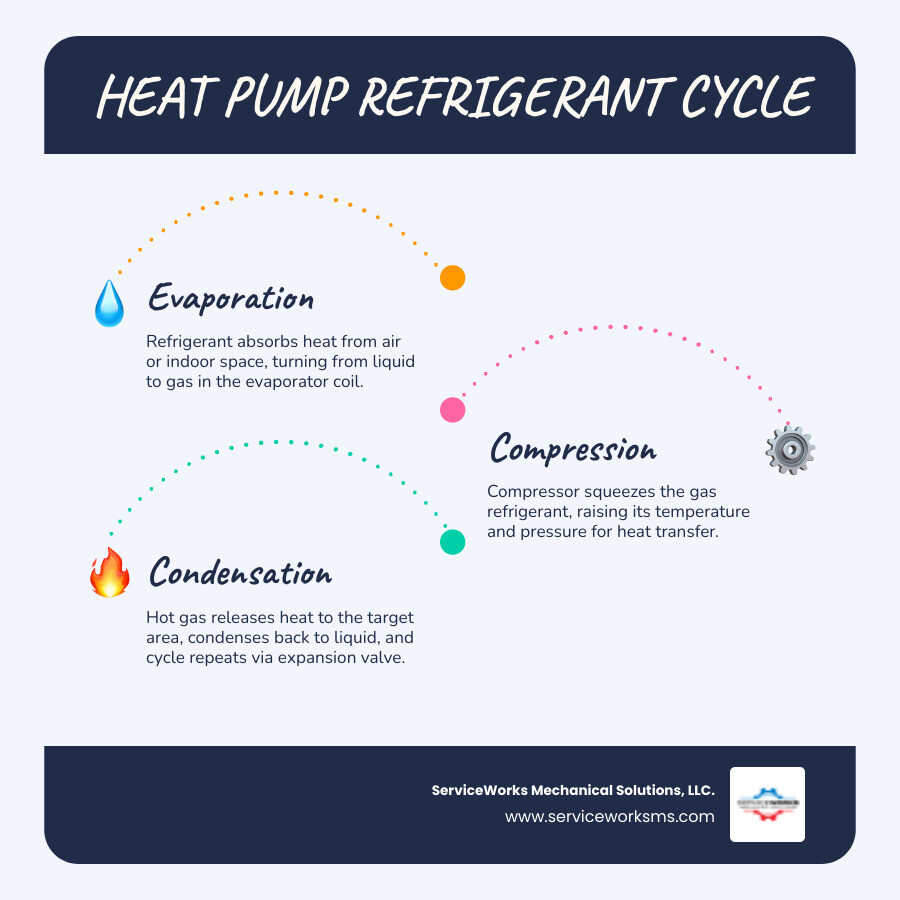
To understand the "how" behind the "wow," we need to look at the four main components that make the refrigerant cycle possible:
- The Compressor: Often called the "heart" of the system, it sits in the outdoor unit. It uses electricity to compress the refrigerant gas, raising its temperature and pressure. Modern units often use variable-speed compressors that can ramp up or down based on exactly how much heating or cooling you need.
- The Condenser: This is the coil where the refrigerant gives up its heat. In cooling mode, this is the outdoor coil; in heating mode, it’s the indoor coil.
- The Expansion Valve: This acts as a regulator. It abruptly reduces the pressure of the liquid refrigerant. Just like an aerosol can feels cold when you spray it, this sudden drop in pressure causes the refrigerant's temperature to plummet, preparing it to absorb more heat.
- The Evaporator: This is the coil where the refrigerant "evaporates" as it absorbs heat.
- The Refrigerant: The "hero" of the story. This is a special fluid with an incredibly low boiling point (often below -15°F), allowing it to change from liquid to gas even in cold weather.
Comparing Heat Pumps to Traditional HVAC Systems
Many homeowners in Charleston and Surfside Beach are used to the traditional combo of a central AC and a gas or electric furnace. Here is how they stack up against a modern heat pump:
| Feature | Heat Pump | Traditional Furnace | Central Air Conditioner |
|---|---|---|---|
| Primary Function | Heating & Cooling | Heating Only | Cooling Only |
| Energy Source | Electricity | Gas, Propane, or Electric | Electricity |
| Efficiency (COP) | 3.0 – 5.0 | 0.80 – 0.98 | N/A (Cooling only) |
| Method | Transfers Heat | Creates Heat (Combustion) | Transfers Heat |
| Carbon Footprint | Low (Zero on-site emissions) | High (Fossil fuel burning) | Moderate |
System Differences to Note:
- Moving vs. Generating: A furnace has to burn fuel to create heat. A heat pump just moves heat that already exists. This is why heat pumps can reach 300% to 400% efficiency, while a "high-efficiency" furnace tops out at about 98%.
- Dual Fuel Systems: In some regions, homeowners use a "hybrid" or dual-fuel system. This combines a heat pump with a gas furnace. The heat pump handles the mild days (which is most of the winter in South Carolina), and the furnace only kicks in during extreme cold snaps.
- Air Temperature: Furnaces produce very hot air (120°F+). Heat pumps produce air that is warm (85°F–95°F), but they move a higher volume of it to keep the house at the same thermostat setting.
Efficiency, Climate Performance, and Environmental Benefits
When shopping for a heat pump in 2026, you’ll see three main ratings: SEER2 (cooling efficiency), HSPF2 (heating efficiency), and COP (Coefficient of Performance).
A well-designed heat pump typically has a COP of 3 to 5. This means for every watt of electricity you put in, you get 3 to 5 watts of heat out. Compare that to an electric space heater, which has a COP of 1.0 (1 watt in, 1 watt out).
Environmental Impact
In regions accounting for 70% of world energy consumption, switching to a heat pump can reduce emissions by over 45% compared to a high-efficiency gas boiler. In the United States, 70% of houses could reduce their carbon footprint by making the switch.
Furthermore, the industry is moving toward more environmentally friendly refrigerants. For example, the 100-year Global Warming Potential (GWP) of propane (R-290) is 0.02, which is approximately 7000 times less than older refrigerants like R-32. By choosing a modern system, you are directly contributing to a cleaner coastal environment.
Frequently Asked Questions about Heat Pump Mechanics
Do heat pumps work in freezing temperatures?
Yes! This is a common myth. While older models struggled when temperatures dropped below 30°F, modern cold climate heat pumps (often called Hyper-Heat or Extended Capacity units) can operate effectively down to -22°F.
In Surfside Beach and Myrtle Beach, our winters rarely see those extremes, meaning a heat pump will operate at peak efficiency almost all year long. On the rare night it drops into the teens, the system may use "backup" electric resistance heat strips to ensure your home stays toasty.
Are heat pumps expensive to operate?
Actually, they are often much cheaper to run than traditional systems. In many regions, HVAC systems with heat pumps are now about 27 percent cheaper to operate than gas boilers. The annual energy consumption of a heat pump typically falls between 6,176 and 10,244 kWh, depending on your home's insulation and size. Because they are 300%+ efficient, you are getting much more "bang for your buck" on your utility bill.
How long do heat pumps typically last?
On average, a heat pump lasts between 10 and 25 years. However, here in coastal South Carolina, we have a unique challenge: salt air. The salt in our breeze can be corrosive to outdoor coils.
That is why professional inspections and preventative maintenance are so critical. We recommend a 65-point inspection twice a year—once in the spring and once in the fall—to clean the coils, check refrigerant levels, and ensure the salt isn't shortening the life of your investment.
Conclusion
Understanding how does a heat pump work is the first step toward a more comfortable, energy-efficient home. Whether you are in Myrtle Beach, Conway, or Summerville, these systems offer a versatile solution to our unique coastal climate. They keep you bone-dry and cool in the humid July heat and provide efficient, reliable warmth during our mild winters.
At ServiceWorks Mechanical Solutions, LLC, we pride ourselves on being your local, veteran-owned HVAC experts. We don't just install equipment; we ensure your home’s air quality and comfort are optimized for the long haul. With our 100% satisfaction guarantee and 24/7 emergency service, you can rest easy knowing your home is in good hands.
I'm looking for professional heat pump services in Surfside Beach — Contact us today to schedule a consultation and see if a heat pump is the right choice for your South Carolina home!
testimonials
Customer Testimonials

With approved credit through Wisetack, you can enjoy zero down financing and convenient monthly payments, so you don’t have to wait to get the comfort you deserve.
Recent Blog
Stay updated with our latest blog posts.


Commercial HVAC Replacement Planning: How to Know When It’s Time to Replace Your System