
When Your AC Can't Keep Up With Surfside Beach's Humid Heat
If you're dealing with ac not cooling properly in humid heat what to check is probably the first thing on your mind — and you're not alone. Coastal South Carolina summers bring a brutal combination of high temperatures and heavy moisture that pushes even well-maintained air conditioners to their limits. When your AC is running but your home still feels sticky and warm, something is off — and catching it early can save you from a bigger, more expensive breakdown.
Here's a quick checklist of the most common things to check first:
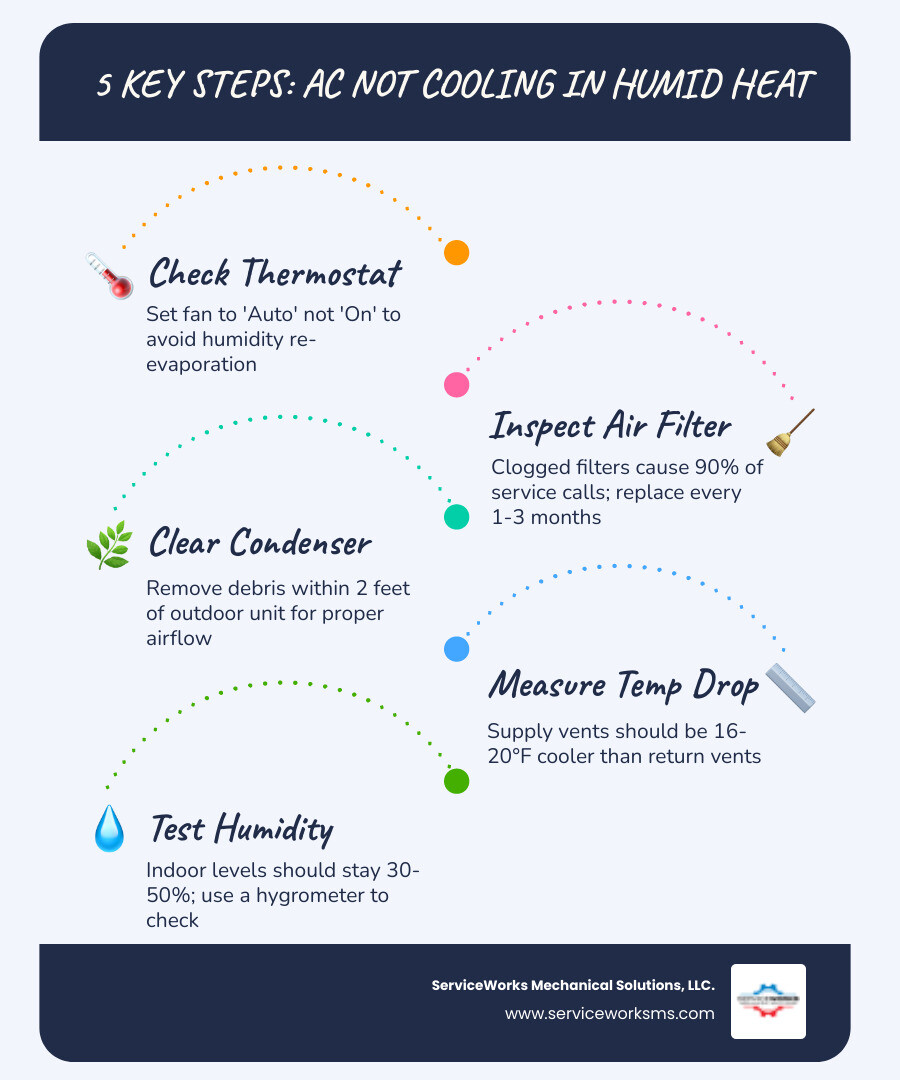
- Thermostat settings - Make sure the fan is set to "Auto," not "On," and the mode is set to "Cool"
- Air filter - A clogged filter is the cause of roughly 9 out of 10 service calls; replace it if it looks gray or packed with dust
- Circuit breakers - Check your electrical panel for any tripped breakers tied to your AC
- Outdoor condenser unit - Clear any debris, overgrowth, or obstructions within two feet of the unit
- Evaporator coils - Look for ice buildup on the indoor unit or refrigerant lines, which signals restricted airflow
- Refrigerant lines - The insulated copper pipe running to the outdoor unit should feel cold and have light condensation on it
- Temperature differential - Measure the air at a supply vent and a return vent; a healthy system drops the temperature by 16 to 20 degrees between the two
- AC unit sizing - An oversized unit cools too fast and shuts off before removing enough moisture, leaving air cold but clammy
- Ductwork - Leaky ducts, especially in hot attic spaces, pull in warm, humid air and undermine cooling
- Indoor humidity level - Use an inexpensive hygrometer; indoor humidity should stay between 30% and 50%
The sections below walk through each of these in detail so you can figure out exactly what's going on with your system.
Why High Humidity Makes Cooling Your Home Harder
In places like Myrtle Beach and Pawleys Island, the humidity isn't just a minor annoyance; it’s a massive workload for your air conditioner. To understand why your ac not cooling properly in humid heat what to check, you first have to understand that your AC has two distinct jobs: lowering the air temperature (sensible heat) and removing water vapor (latent heat).
Moist air contains significantly more heat energy than dry air at the same temperature. When the humidity is high, your AC spends a huge portion of its energy simply wringing the water out of the air before it can even begin to drop the temperature. This is known as the latent heat load. If the air is saturated, the evaporator coil becomes overwhelmed with condensation.
Ideally, indoor humidity levels should be maintained between 30-50%. When levels spike above 60%, the air feels "heavy," and your sweat can't evaporate to cool your body naturally. This makes a 75-degree room feel like 80 degrees.
| Feature | Dry Condition (Low Humidity) | Humid Condition (High Humidity) |
|---|---|---|
| Cooling Speed | Rapid temperature drop | Slow temperature drop |
| Energy Usage | Lower; focuses on sensible heat | Higher; struggles with latent heat |
| Comfort Level | Crisp and cool | Sticky, "clammy" feeling |
| AC Workload | Standard cycles | Long cycles or constant running |
AC not cooling properly in humid heat what to check first
When the heat index hits triple digits in Conway or Georgetown, don't panic and call for a full system replacement just yet. There are several simple DIY checks that can resolve the issue in minutes.
The Thermostat: Your First Line of Defense
Check your thermostat settings immediately. It sounds simple, but it’s common for a family member to accidentally bump the switch to "Heat" or "Fan Only" while cleaning. Ensure it is set to "Cool" and the temperature is at least a few degrees lower than the current room temperature.
The most critical setting for humidity control is the fan mode. Always set your fan to "Auto," not "On." When the fan is set to "On," it runs continuously, even when the cooling compressor is off. This blows air over a wet evaporator coil, pulling all the moisture the AC just removed back into your home. This can cause indoor humidity to spike by 10-15% in a matter of minutes.
Power and Breakers
If the indoor vents are blowing but the air isn't cold, go to your electrical panel. Air conditioners pull a lot of juice during a South Carolina heatwave, and it’s possible a breaker has tripped. Flip it all the way off and then back on to reset it. If it trips again immediately, stop and call us—this indicates a more serious electrical fault.
More info about air conditioning services
Troubleshooting Airflow and Coil Issues
Airflow is the lifeblood of your HVAC system. Without proper movement, the heat exchange process grinds to a halt, leaving you sweltering.
Why your ac is not cooling properly in humid heat what to check regarding air filters
In our experience serving the Grand Strand, a dirty air filter is the most frequent reason an air conditioner stops cooling. In fact, it's the culprit in nine out of ten service calls.
A clogged filter restricts airflow so severely that the refrigerant in the evaporator coil gets too cold because there isn't enough warm air passing over it to "soak up" the heat. By April 2026, modern high-efficiency filters are better at catching pet dander and dust, but they also clog faster.
- Standard homes: Change every 1-3 months.
- Homes with pets or high dust: Change every 30-60 days during peak summer.
Signs of frozen or dirty evaporator coils
If you notice warm air coming from the vents or see a puddle of water around your indoor unit, your evaporator coils might be frozen. High humidity causes massive amounts of condensation; if the airflow is restricted by a dirty filter or dirty coils, that condensation turns to ice.
What to do:
- Turn the AC "Off" at the thermostat.
- Turn the Fan to "On" to help melt the ice.
- Once the ice is gone (usually a few hours), check the filter.
- If the coils are dirty with mold or dust, they need a professional cleaning to restore heat transfer.
More info about air conditioning services
Evaluating System Performance and Sizing
Sometimes the system is working, but it’s just not working well enough. You can perform a "health check" on your AC with a simple thermometer.
Measuring the temperature drop at your vents
To see if your AC is actually performing, measure the "Delta T" or temperature differential.
- Let the AC run for at least 15 minutes.
- Hold a thermometer at the return vent (where air goes into the system).
- Hold it at a supply vent (where cold air comes out).
The Magic Number: Air conditioners should drop the temperature by at least 16 degrees. Ideally, you want to see a difference of 18 to 20 degrees. If the difference is less than 16 degrees, you likely have a refrigerant issue or a failing compressor.
How unit sizing affects ac not cooling properly in humid heat what to check
In places like Charleston and Summerville, bigger is not always better. If your AC unit is oversized, it will cool the air very quickly and then shut off. This is called "short cycling." Because it doesn't run long enough, it never has the chance to remove the humidity. You end up with a home that is 72 degrees but feels damp and clammy.
Conversely, an undersized unit will run 24/7 and never reach the set temperature. If you’ve recently added a sunroom or square footage to your Loris or Little River home, your old unit may no longer be able to keep up with the load.
Outdoor Maintenance and Professional Indicators
Your outdoor unit (the condenser) is responsible for releasing all the heat collected from inside your home. If it can't "breathe," your house won't get cool.
Maintaining the outdoor condenser unit
The outdoor unit needs clear space to exhaust hot air.
- Clearance: Ensure there is at least two feet of clear space around the unit. Remove weeds, tall grass, or stored items.
- Cleanliness: Gently hose down the coils to remove salt spray (common in Surfside Beach and Murrells Inlet), dirt, and pollen. Never use a pressure washer, as it will bend the delicate aluminum fins.
- Bent Fins: If the fins are crushed, use a "fin comb" to straighten them, allowing air to flow through the coils again.
When to call for professional refrigerant and duct repair
If you've checked the filter and the thermostat but your ac not cooling properly in humid heat what to check remains a mystery, it’s time for professional intervention.
Watch for these red flags:
- Hissing or Bubbling: This usually indicates a refrigerant leak. Refrigerant is a closed-loop system; it doesn't "run out" like gas in a car. If it’s low, there is a hole that needs fixing.
- Attic Duct Leaks: In South Carolina, attic temperatures can soar to 130°F. If your ducts have even small leaks, they will suck in that superheated, humid air and blow it straight into your living room.
- Ice on Copper Lines: This is a clear sign of a major airflow blockage or low refrigerant.
At ServiceWorks Mechanical Solutions, LLC, we provide 24/7 emergency service for those brutal July nights when the AC gives up. As a veteran-owned business, we pride ourselves on honest diagnostics and a 100% satisfaction guarantee.
More info about air conditioning services
Frequently Asked Questions about Humid Heat Cooling
Why does my house feel sticky even when the AC is running?
This is usually due to high indoor moisture levels that the AC can't keep up with. It could be caused by an oversized system short-cycling, leaky ductwork pulling in humid air from a crawlspace, or simply extreme outdoor conditions. If your AC is older (most last 10-15 years), it may have lost its dehumidification efficiency. You might consider adding a whole-home dehumidifier to work alongside your AC.
What is the ideal indoor humidity level for a Surfside Beach home?
You should aim for 30-50% humidity. Keeping it under 50% is crucial for mold prevention, dust mite control, and protecting your home’s wood flooring and furniture. If your humidity is consistently above 60%, you are at risk for biological growth and structural damage over time.
How does the "Fan On" setting impact humidity?
Setting the fan to "On" is one of the worst things you can do in a humid climate. It prevents the moisture on the evaporator coil from draining away. Instead, the fan blows that moisture right back into the house. Always use the "Auto" setting so the fan stops when the cooling cycle ends, allowing the water to drip into the condensate pan and out of your home.
Conclusion
Living on the South Carolina coast means accepting the humidity, but you shouldn't have to accept a sticky, uncomfortable home. By following this guide on ac not cooling properly in humid heat what to check, you can handle the simple maintenance tasks like filter changes and thermostat adjustments yourself.
However, when the problem involves refrigerant, electrical components, or complex ductwork issues, you need a team you can trust. ServiceWorks Mechanical Solutions, LLC is your local, veteran-owned expert for everything from Surfside Beach to Columbia. We stand behind our work with a 100% satisfaction guarantee and the technical expertise to keep your home a true sanctuary from the heat.
Don't spend another "clammy" night in your own living room. If your DIY checks didn't solve the problem, give us a call today.
testimonials
Customer Testimonials

With approved credit through Wisetack, you can enjoy zero down financing and convenient monthly payments, so you don’t have to wait to get the comfort you deserve.
Recent Blog
Stay updated with our latest blog posts.

Why Is My Home So Humid? How Your HVAC System Controls Indoor Humidity in South Carolina