
The Real Cost of Hot Water: Gas vs Electric Water Heater Which Is Better for Surfside Beach Homeowners?
Gas vs electric water heater which is better depends mainly on what your home already has — and what your monthly energy bills look like. For most homeowners, there's no single right answer. But there are clear patterns that make one a smarter choice than the other depending on your situation.
Quick Answer: Gas vs. Electric Water Heater
| Factor | Gas Water Heater | Electric Water Heater |
|---|---|---|
| Best for | Large households, high hot water demand | Smaller homes, all-electric setups |
| Upfront cost | Higher | Lower |
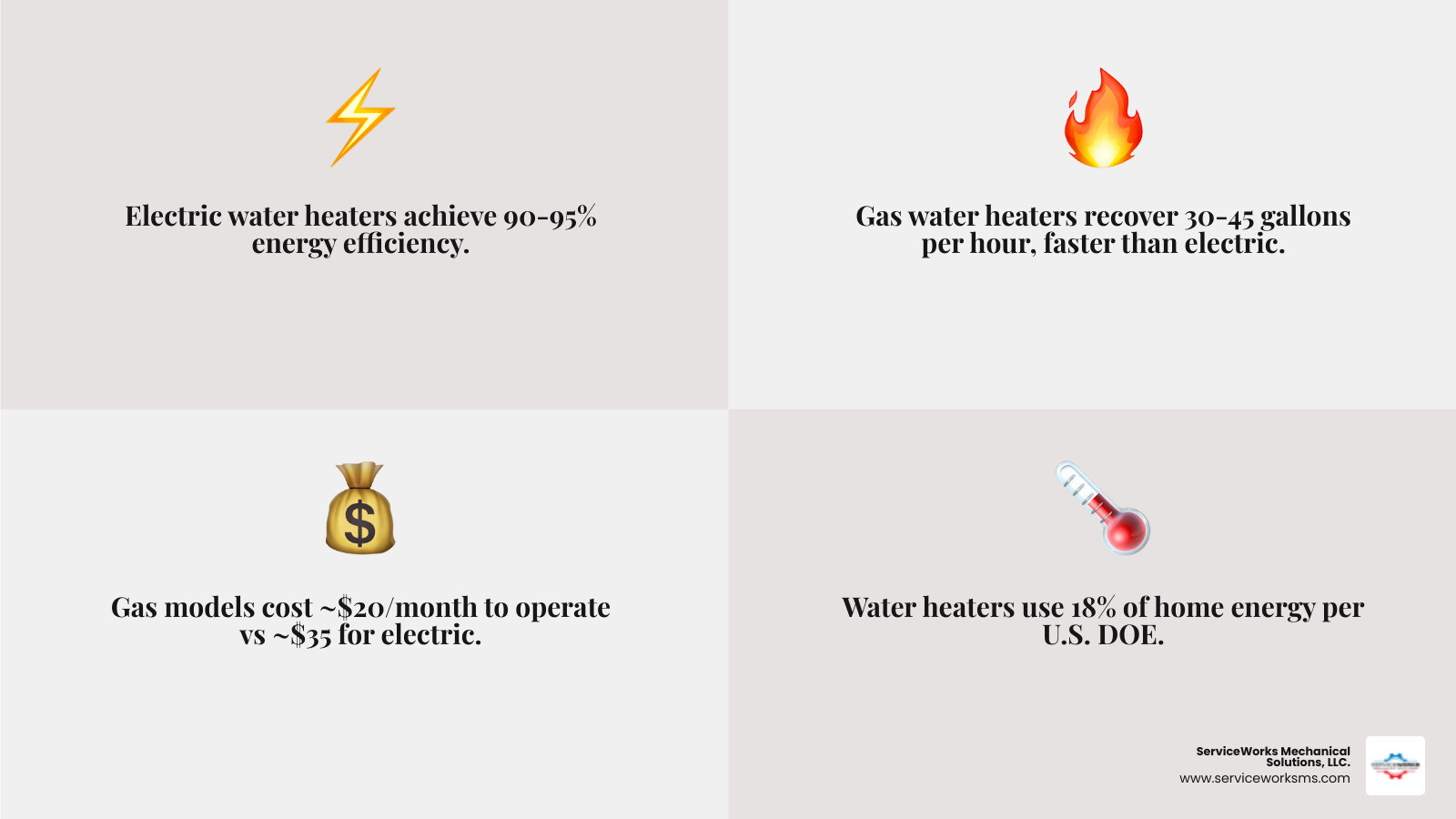
| Monthly operating cost | Lower (~$20/month) | Higher (~$35/month) |
| Energy efficiency | 60–70% | 90–95% |
| Recovery rate | Faster (30–45 gal/hr) | Slower (14–20 gal/hr) |
| Lifespan | 8–12 years | 10–15 years |
| Works during power outage? | Often yes (older models) | No |
| Safety risk | Gas leaks, carbon monoxide | Minimal (no combustion) |
| Environmental impact | Higher (fossil fuels) | Depends on electricity source |
Water heaters quietly handle one of the heaviest workloads in your home — accounting for roughly 18% of your total energy usage, according to the U.S. Department of Energy. That makes choosing the right type a decision that affects your comfort, your utility bills, and your peace of mind every single day.
Here in Surfside Beach, South Carolina, homeowners face a specific set of conditions: coastal humidity, storm season, and homes that vary widely in age and existing infrastructure. Whether you're replacing an aging unit or setting up a new build, the gas vs. electric question comes down to more than just price tags. It's about what works reliably in your home, your climate, and your daily routine.
This guide breaks down every factor that matters — from recovery rates and efficiency to safety, lifespan, and switching costs — so you can make a confident, informed decision.
Deciding on Home Infrastructure: Gas vs Electric Water Heater Which Is Better?
When we walk into a home in Myrtle Beach or Conway to assess a failing unit, the first thing we look at isn't the heater itself—it’s the walls and floors around it. The decision of gas vs electric water heater which is better often begins and ends with the existing energy infrastructure in your home.
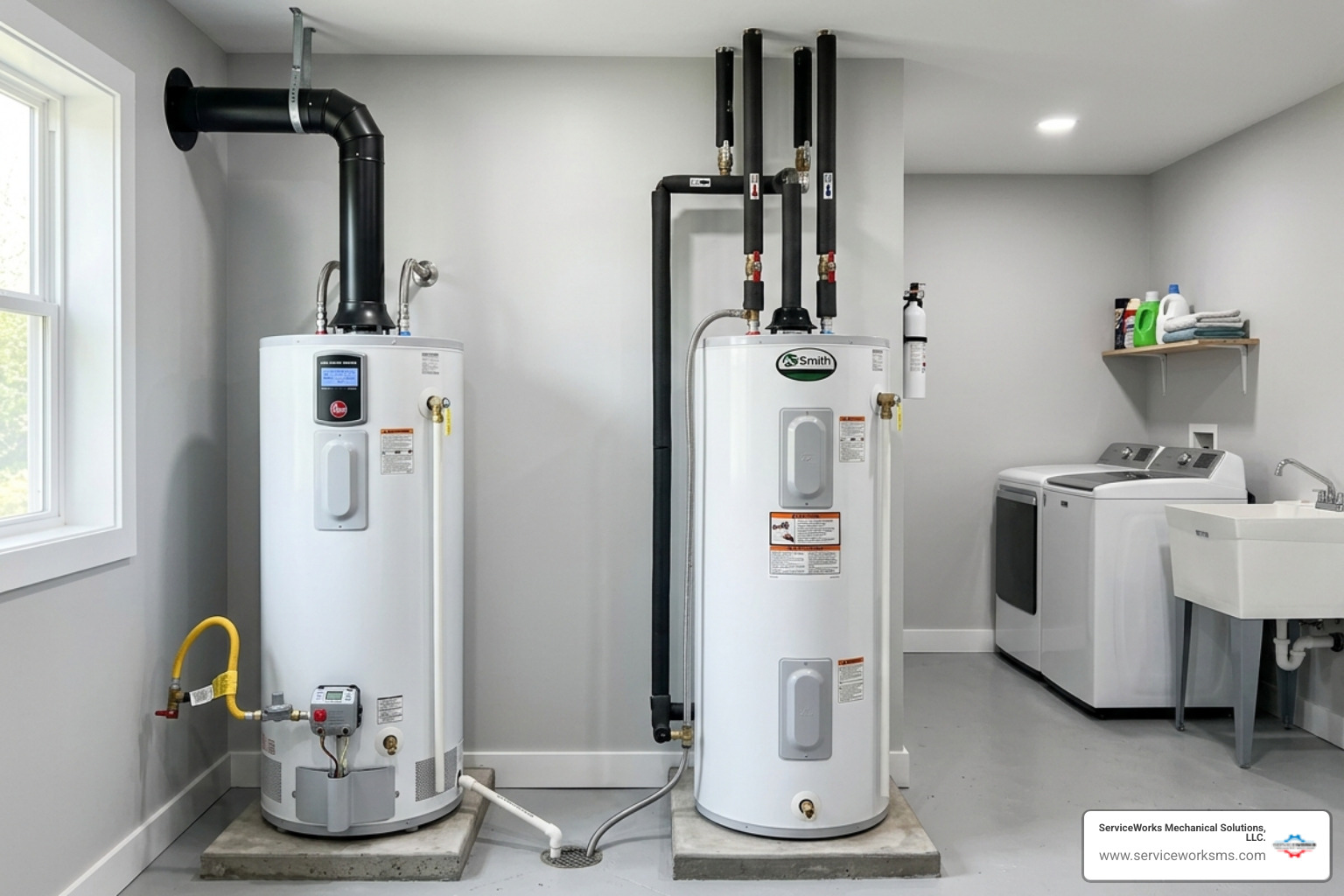
If your home is already piped for natural gas or has a propane tank standing by, a gas water heater is a natural contender. These units use a gas burner at the bottom of the tank to ignite a fuel-air mixture. The heat travels through a central flue or heat exchanger to warm the water. Because this involves combustion, these units require dedicated venting to the outdoors to safely remove carbon monoxide and other byproducts.
On the flip side, many modern developments in areas like Carolina Forest or Socastee are built as all-electric communities. Electric water heaters use high-voltage electrical circuits (typically a dedicated 240-volt, 30-amp circuit) to power internal resistance heating elements. These elements are submerged directly in the water, acting much like a giant electric kettle. Because there is no flame and no exhaust, electric units don't need a chimney or vent pipe, making them much more flexible for installation in tight closets or under stairs.
At ServiceWorks Mechanical Solutions, LLC, we’ve seen that forcing a change in infrastructure—like running a brand-new gas line to a home that has never had one—can be a massive undertaking. For more details on how these systems integrate into your home's plumbing, you can explore more info about water heater services.
Comparing recovery speeds for gas vs electric water heater which is better
If you’ve ever been the third person in line for the shower on a Monday morning, you know all about "recovery rate." This is the measure of how quickly a water heater can take a tank full of cold water and bring it back up to your desired temperature (usually 120 degrees Fahrenheit).
When asking gas vs electric water heater which is better for performance, gas usually takes the trophy. Gas water heaters are the sprinters of the plumbing world. They typically boast a recovery rate of 30 to 45 gallons per hour. This means that even in a busy household with back-to-back showers and a dishwasher running, a gas unit can keep up with the demand. A 40-gallon gas unit can often outperform a 50-gallon electric unit simply because it works faster.
Electric models, while efficient, are more like marathon runners. They have a slower recovery rate, typically averaging 14 to 20 gallons per hour. If you drain the tank with a long soak in the tub, you might be waiting a while for the next hot shower. For smaller households or couples in Surfside Beach, this might not be an issue. But for larger families, that slow recovery can lead to some chilly surprises.
Environmental impact of gas vs electric water heater which is better
In April 2026, many of our neighbors are looking at their carbon footprint as much as their bank accounts. The environmental debate between gas and electric is nuanced.
Gas water heaters rely on fossil fuels—either natural gas or propane. While natural gas is a cleaner-burning fossil fuel than coal, it still produces direct greenhouse gas emissions during combustion. There is also the environmental impact of extraction and the potential for methane leaks in the supply chain.
Electric water heaters produce zero emissions at the point of use. However, their true "greenness" depends entirely on where your electricity comes from. If your local grid is powered by coal or gas, the environmental benefit is lower. But as South Carolina continues to integrate more renewable energy sources like solar, electric water heaters become an increasingly eco-friendly choice.
Efficiency plays a role here, too. Electric units are incredibly efficient at converting energy into heat, with ratings often between 90% and 95%. Gas units lose some heat through the venting process, typically landing between 60% and 70% efficiency, though high-efficiency condensing models can reach 80% or more.
Performance and Efficiency in the Coastal South Carolina Climate
Living near the coast means dealing with high humidity and the occasional extreme weather event. These factors can actually influence which water heater performs better for you.
| Feature | Standard Gas Tank | Standard Electric Tank |
|---|---|---|
| Energy Conversion | 60–70% (Heat lost via vent) | 90–95% (Direct immersion) |
| Recovery Rate | 30–45 Gallons/Hour | 14–20 Gallons/Hour |
| Standby Loss | Moderate (Center flue loses heat) | Low (Better insulation) |
| Venting Needs | Required (Exterior wall/roof) | None |
| Coastal Durability | Burners can be sensitive to salt air | Elements are protected inside tank |
In Surfside Beach, the ambient temperature of our groundwater is generally warmer than it is up North. This means our heaters don't have to work quite as hard to reach 120 degrees. However, the high salt content in our air can be tough on any appliance with outdoor-facing vents. Gas units require proper, clear venting to ensure the burner gets enough oxygen and stays free of corrosion.
Electric units, because they are completely sealed and have no intake or exhaust, often fare slightly better in high-humidity environments where ventilation might otherwise introduce salty, moist air into the burner chamber.
Long-Term Reliability and Maintenance Requirements
No water heater lasts forever, but with the right care, you can stretch its life significantly. We generally see that electric water heaters last longer, typically 10 to 15 years, compared to the 8 to 12 years expected from a gas model.
Why the difference? Gas units have more moving parts and subject the tank to more intense, direct heat from the burner at the bottom. This constant thermal stress can lead to faster tank fatigue.
Maintenance is the key to longevity. For both types, we recommend an annual tank flush. In areas with hard water, minerals like calcium and magnesium settle at the bottom of the tank. In a gas unit, this sediment acts as an insulator, making the burner work harder and eventually causing the tank to overheat and crack. In an electric unit, sediment can bury the lower heating element, causing it to burn out prematurely.
Another critical component is the anode rod. This "sacrificial" rod hangs inside the tank and attracts corrosive elements in the water so they eat the rod instead of the tank. Checking this rod every few years can double the life of your heater. For professional help keeping your system running, check out more info about water heater services.
Safety considerations for gas vs electric water heater which is better
Safety is often the top concern for families in Charleston and Georgetown. Both types of heaters are incredibly safe when installed correctly by licensed professionals, but they carry different risks.
Gas Water Heater Risks:
- Carbon Monoxide (CO): If the venting system is blocked or damaged, CO can backdraft into the home. We always recommend installing CO detectors near gas appliances.
- Gas Leaks: While rare, a leak in the supply line or a failed valve can create a fire hazard.
- Pilot Lights: Older models with standing pilot lights can go out, though modern electronic ignitions have largely solved this.
Electric Water Heater Risks:
- Electrical Short: Because water and electricity don't mix, a poorly wired unit or a leak that reaches the electrical panel can cause a short or fire.
- Dry Firing: If the heating elements are turned on when the tank is empty, they will burn out almost instantly.
Overall, electric heaters are considered "safer" by many because they eliminate the risk of combustion and gas-related issues. However, a gas heater with modern safety shut-offs and proper venting is a very secure appliance.
Advanced Options: Tankless and Hybrid Systems
If you're looking for the "best of the best" in April 2026, you might want to look beyond the traditional tank.
Tankless Water Heaters:Available in both gas and electric, these units heat water on demand rather than keeping a big tank hot 24/7.
- Pros: They take up very little space (mounting on a wall) and provide an endless supply of hot water. They can save up to 35% in energy costs compared to tank models.
- Cons: They have a higher upfront cost and may require upgrades to your gas line or electrical panel.
Hybrid Heat Pump Water Heaters:This is an electric option that is taking the industry by storm. Instead of using resistance elements, it pulls heat from the surrounding air and moves it into the water—much like an air conditioner in reverse.
- Pros: They are 2 to 3 times more efficient than standard electric heaters. They also dehumidify the space they are in, which is a huge bonus in a South Carolina garage or crawlspace!
- Cons: They need more space (at least 1,000 cubic feet of air) and can be noisier than standard units.
If you're curious about making the jump to high-efficiency tech, you can find more info about water heater services on our specialized service page.
Frequently Asked Questions about Water Heater Selection
How can I tell if my current water heater is gas or electric?
It’s easier than you might think! Take a look at your unit:
- If it's Gas: You’ll see a metal vent pipe coming off the top. There will be a small gas line (usually yellow or black) leading to a control valve near the bottom. You might also see a small window where a pilot light or burner glow is visible.
- If it's Electric: There will be no vent pipe. Instead, you’ll see a heavy-duty electrical cable (often in a flexible metal conduit) entering the top or side of the unit. You'll also see two metal access panels on the side of the tank where the heating elements are located.
Does a gas water heater work during a power outage?
This is a big one for our coastal neighbors during hurricane season.
- Older Gas Models: If your heater has a traditional standing pilot light, it will work perfectly fine during a power outage because it doesn't need electricity to operate the gas valve.
- Modern Gas Models: Many newer high-efficiency units use electronic ignition or power-venting fans. These will not work during an outage unless you have a backup generator or battery system.
- Electric Models: These will never work during a power outage. However, because the tank is insulated, the water inside will stay warm for several hours if you don't use it.
Is it worth switching from electric to gas or vice versa?
Switching fuel sources is usually a major project.
- Electric to Gas: This is often the most expensive switch. You have to run new gas lines, install a venting system through your roof or wall, and potentially pay for a new gas meter. It’s usually only worth it if you are doing a major renovation and already have gas in the house.
- Gas to Electric: This is slightly easier but may require an electrical panel upgrade. If your current panel is full, adding a 30-amp water heater circuit can be a significant addition.
In most cases, we recommend sticking with the fuel source your home was designed for unless you have a specific reason to change (like moving to a hybrid heat pump for massive energy savings).
Conclusion: Expert Guidance for Your Surfside Beach Home
Choosing between gas vs electric water heater which is better isn't just about the unit—it's about your home’s infrastructure, your family's hot water habits, and your long-term budget. Whether you prefer the lightning-fast recovery of gas or the simple, efficient operation of electric, the most important factor is a professional installation.
At ServiceWorks Mechanical Solutions, LLC, we are proud to be a veteran-owned company serving Surfside Beach, Pawleys Island, Murrells Inlet, and the surrounding areas. We understand the unique demands the South Carolina climate puts on your home's systems. From 24/7 emergency repairs to expert new installations, we back our work with a 100% satisfaction guarantee.
Don't spend another morning shivering in a cold shower. Whether you need a quick repair or a full system replacement, our team is ready to help you find the perfect hot water solution for your lifestyle.
Contact our Surfside Beach water heater experts today to schedule your consultation!
testimonials
Customer Testimonials

With approved credit through Wisetack, you can enjoy zero down financing and convenient monthly payments, so you don’t have to wait to get the comfort you deserve.
Recent Blog
Stay updated with our latest blog posts.
Commercial Building Maintenance Schedule: What to Check and When