Why Knowing How to Choose the Right Water Heater for Your Home Can Save You Time, Money, and Cold Showers
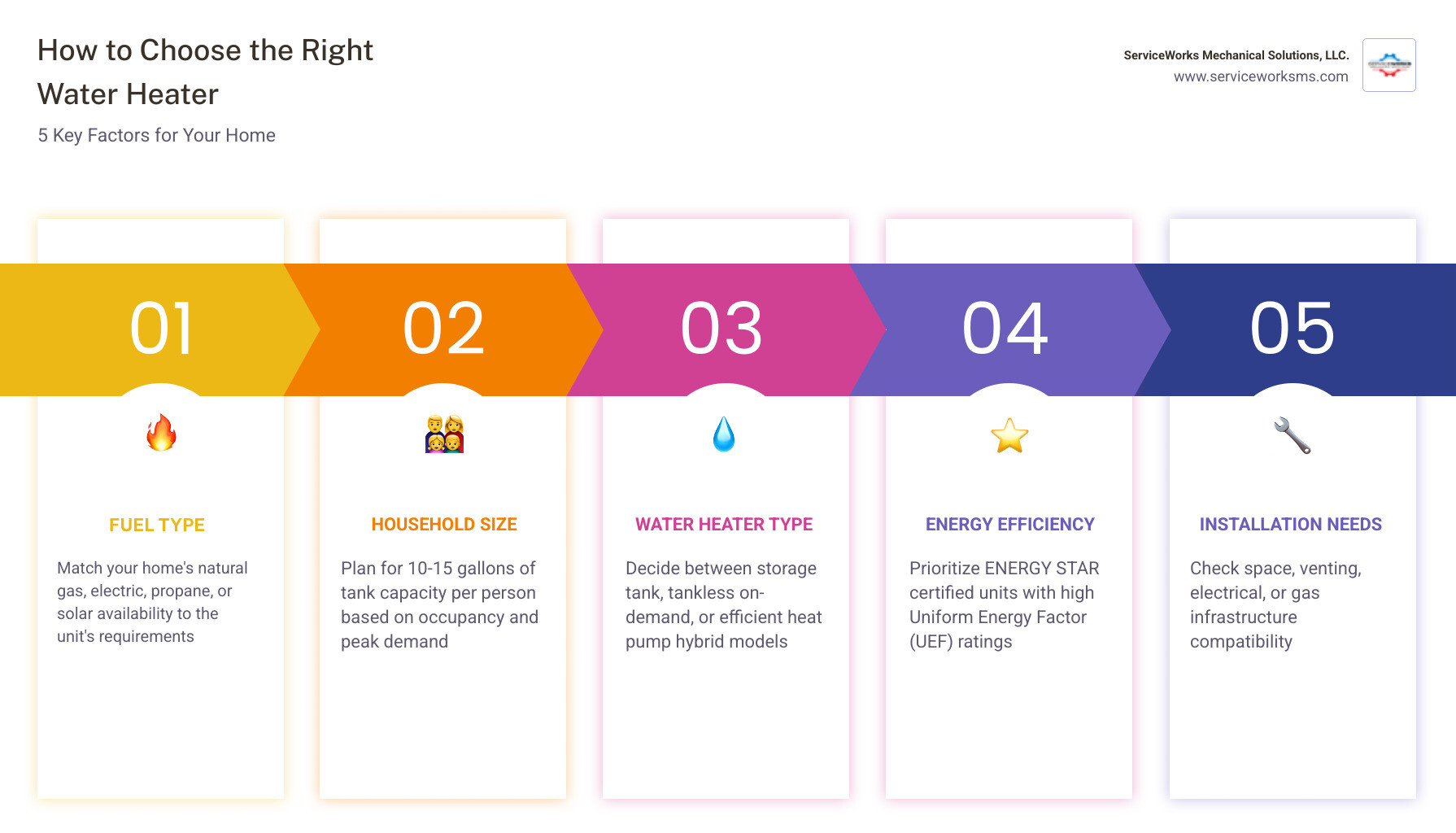
How to choose the right water heater for your home comes down to five key factors:
- Fuel type available - electric, natural gas, propane, or solar
- Household size - use 10-15 gallons of tank capacity per person as a starting point
- Water heater type - storage tank, tankless, or heat pump (hybrid)
- Energy efficiency rating - look for ENERGY STAR certification and a high UEF score
- Installation requirements - space, venting, and electrical or gas infrastructure in your home
Most Surfside Beach, SC homeowners don't think about their water heater until something goes wrong — a cold shower on a January morning, a puddle on the utility room floor, or an energy bill that suddenly jumped up. The truth is, water heating accounts for roughly 18% of a home's total energy use, making it the second-largest energy expense behind heating and cooling. That's a big deal, especially along the South Carolina coast where humidity, hard water minerals, and year-round hot water demand put real stress on these systems.
The good news: choosing the right unit doesn't have to be complicated. Whether your current water heater is aging out, you're dealing with inconsistent hot water, or you simply want to cut your utility bills, this guide walks you through everything you need to know — clearly and without the jargon.
How to Choose the Right Water Heater for Your Home in Coastal South Carolina
Living in coastal South Carolina presents unique challenges for home appliances. Between the high humidity of our summers and the mineral content in our local water, your water heater works hard every single day. We often see homeowners waiting until their unit bursts or leaks before they start shopping. This usually leads to a "panic purchase" where you end up with whatever is in stock, rather than what is best for your long-term budget.
Taking a proactive approach is the smartest move you can make. By planning your replacement before an emergency strikes, you can evaluate high-efficiency models that might save you thousands of dollars over the next decade. For a deeper dive into local considerations, check out our Water Heater Replacement Guide Surfside Beach SC.
How to choose the right water heater for your home based on fuel availability
The first step in the selection process is looking at what powers your home. In our service areas like Murrells Inlet and Myrtle Beach, most homes rely on one of three sources:
- Electricity: The most common fuel source in South Carolina. Electric units are generally easier to install and don't require venting, though they can be more expensive to operate unless you choose a high-efficiency heat pump model.
- Natural Gas: If your home already has gas lines, a gas water heater can be a powerhouse. They typically heat water faster than standard electric tanks and can cost about half as much to run. However, they do require proper outdoor venting to safely move carbon monoxide out of the home.
- Propane: Often found in more rural areas or specific developments, propane offers similar performance to natural gas but requires an on-site storage tank.
- Solar Energy: While less common, the South Carolina sun makes solar water heating a viable long-term investment, though it usually requires a backup system for cloudy days.
If you are thinking about switching from one fuel type to another—say, going from gas to electric—keep in mind that this involves infrastructure changes, such as running new gas lines or upgrading your electrical panel. If you need help weighing these options, our team provides expert Water Heater Replacement Murrells Inlet SC services to ensure your home’s infrastructure is ready for the upgrade.
How to choose the right water heater for your home using household size
Sizing is where many people get stuck. If the tank is too small, you’re looking at cold showers by the time the third person hits the bathroom. If it’s too large, you’re paying to keep 80 gallons of water hot when you only need 40.
A solid rule of thumb is to allow 10 to 15 gallons of tank capacity per person in your home.
- 1-2 People: 30-40 gallons
- 2-3 People: 40-50 gallons
- 3-4 People: 50-60 gallons
- 5+ People: 80 gallons or more
However, occupancy isn't the only factor. We also look at your "peak hour demand." Do you run the dishwasher while two people are showering in the morning? Do you have an oversized soaking tub that requires a massive amount of hot water all at once? These usage patterns dictate whether you need a larger storage tank or a tankless system with a high flow rate. For residents in Socastee, we offer specialized Water Heater Installation Socastee SC to help calculate these exact needs.
Recognizing the Signs: When to Consider a New Unit
Water heaters typically last between 10 and 15 years. If your unit is celebrating its tenth birthday, it’s officially on "borrowed time" watch. Here are the red flags that suggest you should call us for a look:
- Rumbling or Popping Noises: This is usually the sound of sediment buildup. Over time, minerals like calcium and magnesium settle at the bottom of the tank. As the water heats, bubbles of steam push through the sediment, creating those loud knocks. This sediment also acts as an insulator, making your heater work much harder and eventually causing the tank to overheat and fail.
- Rusty or Discolored Water: If the water coming out of your hot taps looks like tea, it could mean the inside of your tank is corroding. This often happens after the sacrificial anode rod—a part designed to rust so your tank doesn't—has completely dissolved.
- Inconsistent Temperatures: If your showers are fluctuating between lukewarm and scalding, or if you’re running out of hot water much faster than you used to, the heating elements or gas burner may be failing.
- Visible Leaks: Any moisture around the base of the tank is an emergency. A small leak today can become a flooded basement or utility room tomorrow.
If you notice any of these symptoms, don't wait for a total breakdown. Early intervention can often lead to a simple repair, but if the tank itself is compromised, replacement is the only safe option. For quick diagnostics, we provide Water Heater Repair Myrtle Beach SC to get your system back on track.
Comparing Systems: Tank, Tankless, and Hybrid Options
Choosing the right technology is the most impactful decision for your monthly budget. Here is how the three main options stack up in 2026:
| Feature | Storage Tank | Tankless (On-Demand) | Heat Pump (Hybrid) |
|---|---|---|---|
| Upfront Cost | Lowest | Moderate to High | Moderate to High |
| Efficiency | Standard | High (No standby loss) | Extremely High (4x+) |
| Lifespan | 10-15 Years | 20+ Years | 13-15 Years |
| Hot Water Supply | Limited by tank size | Endless (Continuous) | Limited by tank size |
| Space Required | Large footprint | Compact/Wall-mounted | Large (Needs airflow) |
Storage tanks remain the most common choice because of their lower initial cost, but they suffer from "standby loss"—meaning they use energy to keep water hot even when you’re asleep or at work. Tankless and hybrid models are quickly gaining ground in South Carolina due to their superior efficiency. For a complete breakdown of how these technologies perform in our local climate, see our Tankless Water Heater Myrtle Beach Guide.
Benefits of Tankless Technology
Tankless water heaters are often called "on-demand" because they only heat water when a tap is turned on. When you open the hot water valve, cold water travels through a heat exchanger where a powerful burner or electric element flashes it to the desired temperature instantly.
The biggest draws for tankless systems include:
- Endless Hot Water: You can take a two-hour shower (though we don't recommend it for your water bill!) without the water ever getting cold.
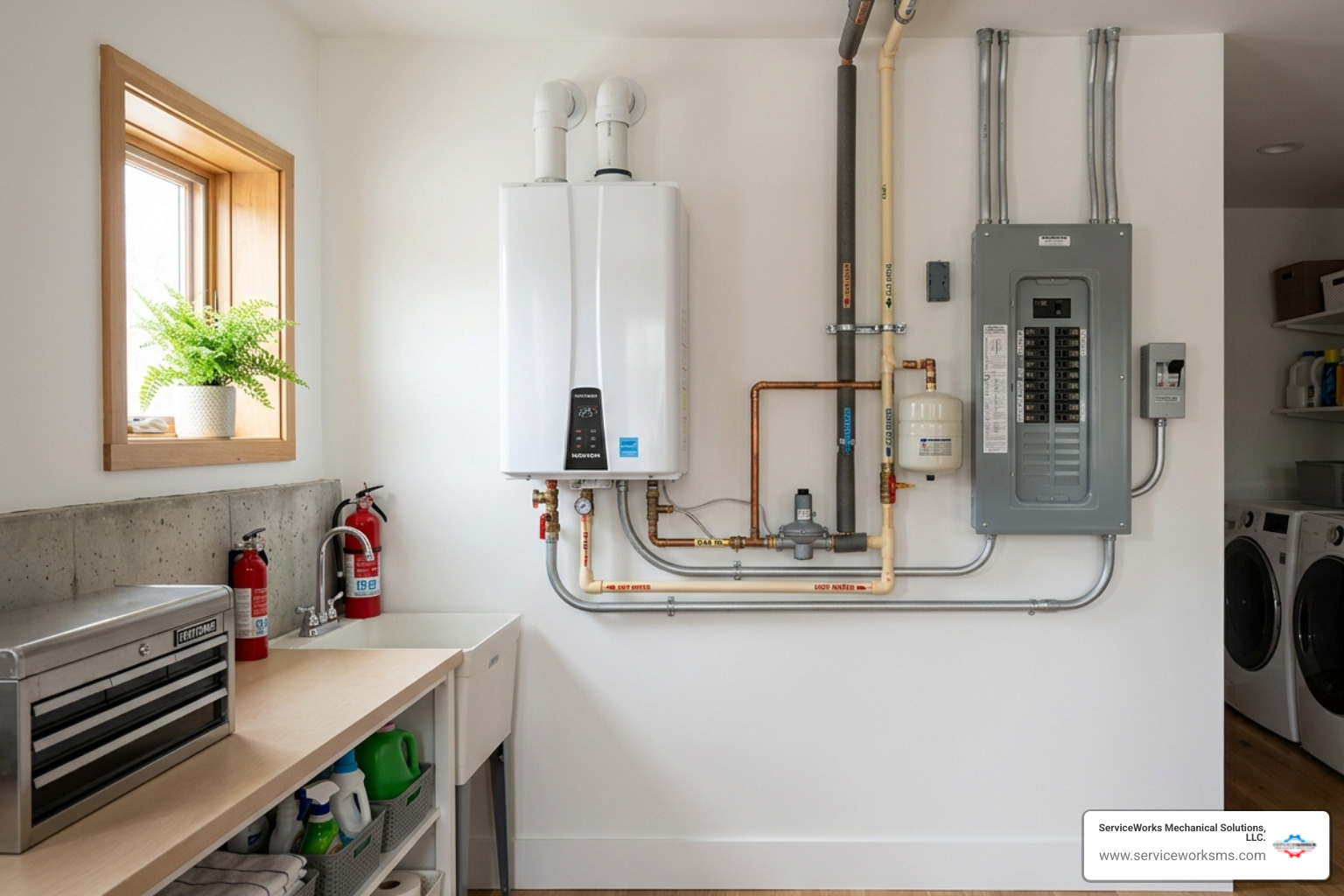
- Space Savings: These units are about the size of a suitcase and mount to the wall, freeing up valuable floor space in your garage or utility closet.
- Longevity: Because they don't store water, they aren't as prone to the corrosion that kills tank models. With proper maintenance, they can easily last 20 years.
If you’re in the Conway area and tired of running out of hot water, our Tankless Water Heater Conway SC Guide explains exactly how these systems handle the demands of a modern household.
The Rise of Heat Pump Water Heaters
Heat pump water heaters—often called hybrid units—are the most efficient electric option on the market today. Instead of creating heat through resistance (like a toaster), they pull heat from the surrounding air and transfer it into the water.
In coastal South Carolina, these units have a secret advantage: dehumidification. Because they pull heat from the air, they naturally exhaust cooler, drier air. Installing one in a humid garage or utility room can help keep the space more comfortable. They are up to four times more efficient than standard electric tanks, which can lead to massive savings on your annual energy costs. To see if a hybrid model is right for your home, check out our Water Heater Replacement Summerville SC Guide.
Sizing and Efficiency: Getting the Perfect Fit
When you look at a water heater's spec sheet, you’ll see several acronyms that are vital for how to choose the right water heater for your home.
- First Hour Rating (FHR): For tank models, this tells you how many gallons of hot water the unit can provide in its first hour of operation starting with a full tank. This is much more important than the tank size itself because it accounts for how quickly the unit can reheat water.
- Gallons Per Minute (GPM): For tankless models, this measures how much hot water the unit can deliver at once. A shower typically uses 2 GPM. If you want to run two showers and a dishwasher simultaneously, you’ll need a unit rated for at least 5-6 GPM.
- Uniform Energy Factor (UEF): This is the official Department of Energy (DOE) measure of efficiency. The higher the number, the more efficient the unit. Standard tanks might have a UEF around 0.6 to 0.9, while heat pumps can reach 3.0 or higher.
Getting these numbers right requires a professional assessment of your home's plumbing. We provide expert Water Heater Installation Mount Pleasant SC to help homeowners navigate these technical specs.
Understanding UEF and ENERGY STAR
Always look for the ENERGY STAR label. Units with this certification meet strict energy-efficiency guidelines set by the EPA and DOE. Beyond just lowering your monthly bills, high-efficiency units often qualify for federal tax credits (up to $2,000 for heat pumps) and local utility rebates.
In areas like Florence, we help customers maximize these incentives to offset the higher upfront cost of premium models. Learn more about local efficiency standards at Water Heater Replacement Florence SC.
Smart Features and Advanced Technology
Modern water heaters are smarter than ever. In 2026, we highly recommend looking for units with:
- Wi-Fi Connectivity: Control your water temperature from your phone and set "vacation mode" when you’re away from home to save energy.
- Leak Detection: Built-in sensors can detect a leak as small as a few drops and send an alert to your smartphone.
- Automatic Shut-off: Some high-end models will automatically shut off the water supply if a leak is detected, preventing catastrophic water damage.
These features provide peace of mind that was impossible just a decade ago. For residents in Georgetown looking for the latest tech, our Water Heater Installation Georgetown SC team can show you the newest smart models.
Installation and Maintenance for Long-Term Performance
A high-quality water heater is only as good as its installation. Proper venting for gas units is a life-safety issue, and ensuring the electrical connections are sufficient for a new heat pump unit is critical. Once installed, the key to longevity is routine maintenance.
In South Carolina, the minerals in our water can shorten a heater's life significantly if it isn't cared for. We recommend an annual "tune-up" to keep things running smoothly. If you’re in Conway, our Water Heater Repair Conway SC experts can help set up a recurring maintenance plan.
Routine Maintenance Tasks
What does a maintenance visit actually involve?
- Flushing the Tank: We drain the tank to remove the sediment and mineral buildup that causes rumbling and inefficiency.
- Anode Rod Inspection: We check the "sacrificial" rod to see if it has dissolved. Replacing a $50 rod can save a $1,500 tank.
- T&P Valve Check: The Temperature and Pressure relief valve is a safety device that prevents the tank from exploding if pressure gets too high. We test it to ensure it isn't stuck.
- Descaling (for Tankless): Tankless units need a specialized flush to remove scale from the heat exchanger tubes.
Regular care is especially important in Loris, where water hardness can vary. Check out Water Heater Repair Loris SC for more on local maintenance needs.
Frequently Asked Questions about Water Heaters
How long do different types of water heaters typically last?
Standard storage tanks generally last 10 to 15 years. Tankless units can last 20 years or more with proper maintenance. Heat pump models typically fall in the 13 to 15-year range. The biggest factor in lifespan is water quality and whether or not the unit was flushed regularly. If you need a replacement in Loris, visit Water Heater Replacement Loris SC.
Is a tankless water heater better for a large family?
It can be! A tankless unit provides endless hot water, which is great for back-to-back showers. However, you must ensure the unit has a high enough GPM (Gallons Per Minute) to handle simultaneous demand. If two people shower while the laundry is running, a small tankless unit might struggle. For advice on high-capacity systems, see Tankless Water Heater Florence SC.
What are the space requirements for a heat pump water heater?
Heat pump units need roughly 1,000 cubic feet of air space around them to operate efficiently (that’s about the size of a 10x12 room). They shouldn't be tucked into a tiny closet unless that closet has louvered doors for airflow. Our team at Water Heater Installation Charleston SC can help you determine if your utility room has enough clearance.
Conclusion
Choosing the right water heater is an investment in your home’s comfort and your family’s daily routine. At ServiceWorks Mechanical Solutions, LLC, we bring veteran-owned expertise and a commitment to 100% satisfaction to every job. Whether you are in Surfside Beach, Columbia, or anywhere in between, our licensed technicians are ready to help you find the perfect balance of efficiency and performance.
From 24/7 emergency repairs to precision installations, we treat your home like our own. Don't wait for your old unit to leave you in the cold. Contact us today to explore our full range of Water Heater Services and start saving on your energy bills!
testimonials
Customer Testimonials

With approved credit through Wisetack, you can enjoy zero down financing and convenient monthly payments, so you don’t have to wait to get the comfort you deserve.
Recent Blog
Stay updated with our latest blog posts.
Why Is My Home So Humid? How Your HVAC System Controls Indoor Humidity in South Carolina