



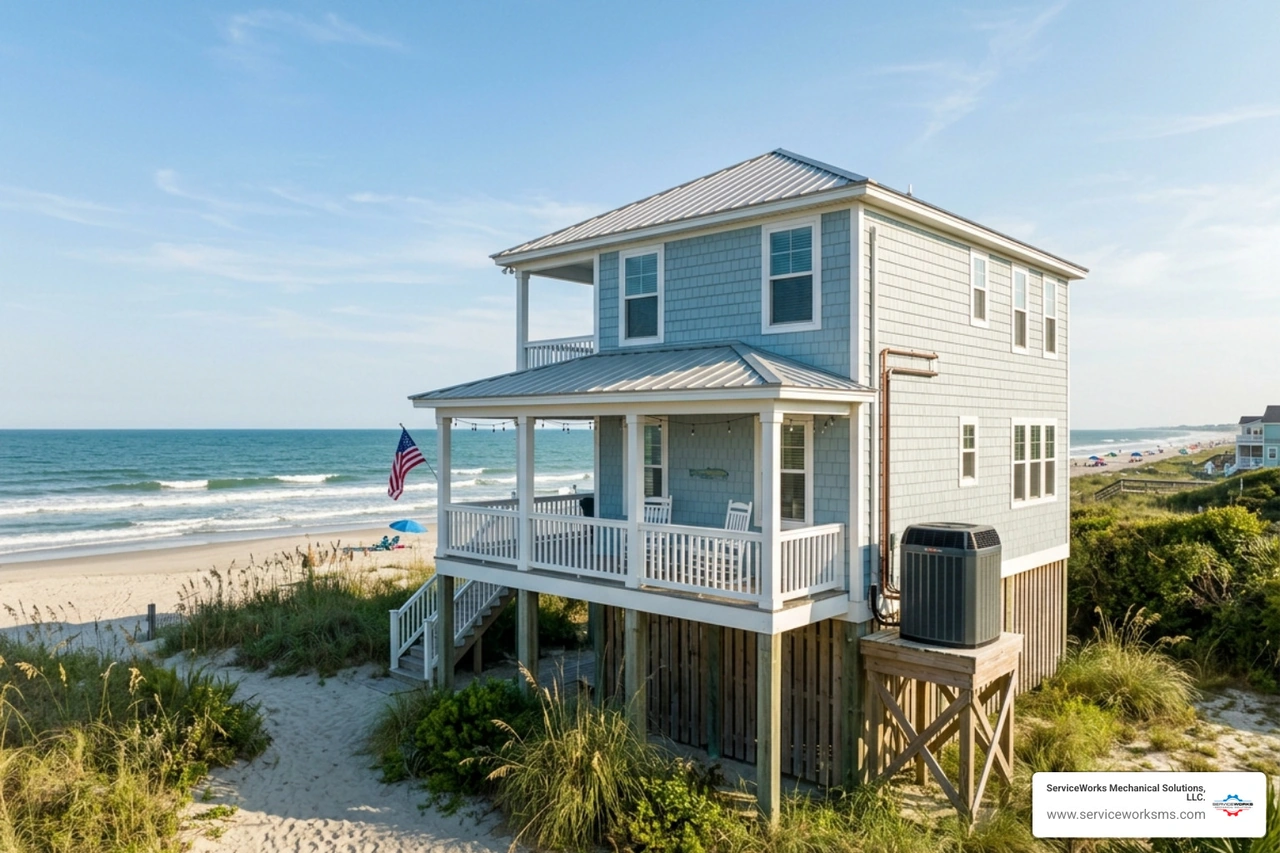
Why the Coastal South Carolina Climate Is One of the Hardest Environments for Any HVAC System
How coastal south carolina climate affects your hvac is something every homeowner in Surfside Beach and the surrounding Lowcountry needs to understand — because this region is genuinely one of the most demanding environments for residential HVAC systems in the entire United States.
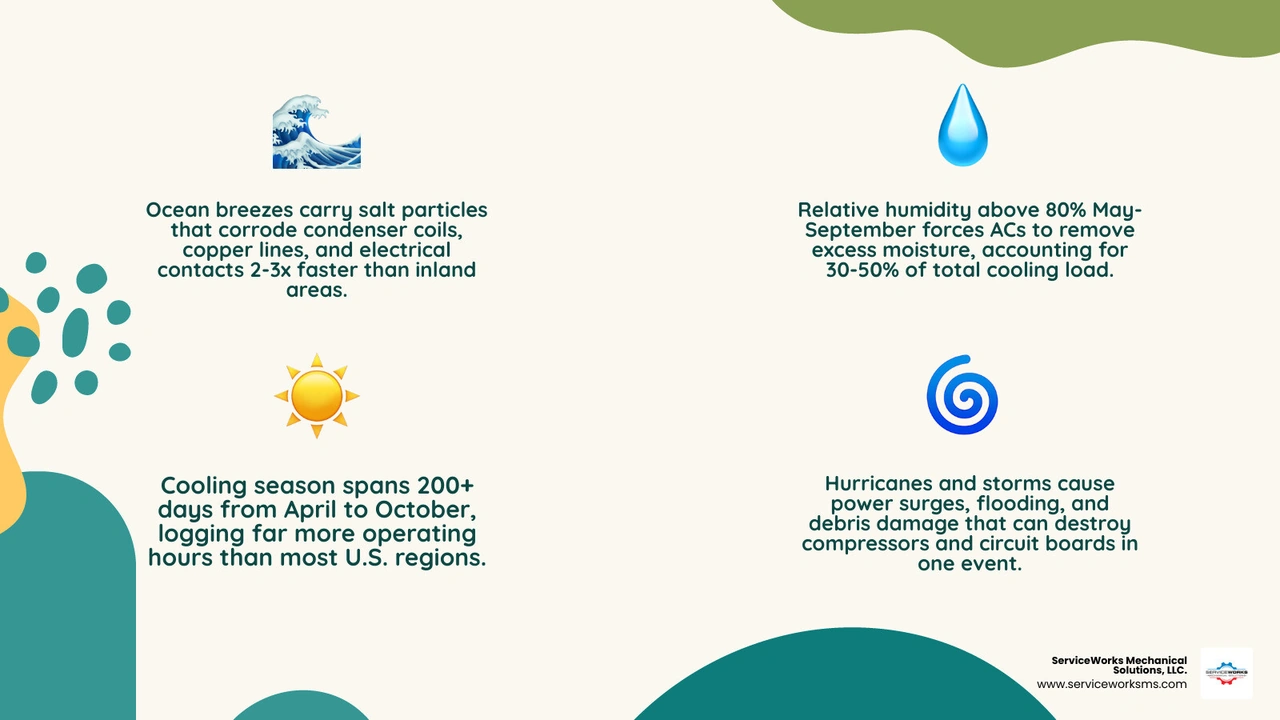
Here is a quick breakdown of the four main climate stressors working against your system right now:
- Salt air corrosion — Ocean breezes carry salt particles that settle on outdoor condenser coils, copper refrigerant lines, and electrical contacts, eating through metal components far faster than in inland areas
- Extreme humidity — Relative humidity sits above 80% from May through September, forcing your AC to work as a massive dehumidifier on top of cooling your home, which dramatically increases wear
- Extended cooling season — The Lowcountry cooling season stretches from April through October, sometimes 200+ days, logging far more operating hours per year than systems in most other U.S. markets
- Storms and power surges — Hurricane season brings flying debris, flooding, and electrical surges that can damage compressors, circuit boards, and outdoor units in a single event
The numbers tell a stark story. A well-maintained HVAC system earns a 15- to 20-year lifespan in most parts of the country. In coastal South Carolina, that same system may realistically last only 10 to 13 years — and without proper care and protective measures, salt air exposure alone can cut that down to just 5 to 7 years.
South Carolina falls within ASHRAE Climate Zone 3A, classified as hot-humid, where latent cooling — the energy your system uses just to pull moisture out of the air — can account for 30 to 50 percent of your total cooling load during peak summer months. That is not a minor inconvenience. That is a fundamental shift in how hard your equipment has to work every single day.
If you live in Surfside Beach or anywhere along the Grand Strand, your HVAC system is not just keeping you comfortable — it is fighting the coast every hour it runs.
How Coastal South Carolina Climate Affects Your HVAC Performance and Lifespan
When we talk about the lifespan of an air conditioner, we usually think in years. But in the Lowcountry, it is more accurate to think in "operating hours." Because our cooling season is so long—stretching from the first humid days of April 2026 well into October—a 12-year-old system in Charleston or Myrtle Beach has often logged the same amount of work as an 18-year-old system in the Midwest.
The impact of how coastal south carolina climate affects your hvac is most visible when you compare coastal units to those just a few dozen miles inland. In a place like Florence or Summerville, a system might realistically deliver 12 to 14 years of service. However, move that same unit to a beachfront property in Pawleys Island or a home near the marsh in Mount Pleasant, and that lifespan can drop significantly.
| Location | Typical HVAC Lifespan (Maintained) | Lifespan Without Maintenance |
|---|---|---|
| National Average | 15–20 Years | 10–12 Years |
| Inland SC (Summerville/Florence) | 12–14 Years | 8–10 Years |
| Coastal SC (Surfside/Charleston) | 10–13 Years | 5–7 Years |
Without a proactive approach, salt and humidity become a "silent tax" on your home investment. Recognizing the 5 Common Signs Your Myrtle Beach Home Needs AC Repair Before Summer Hits is the first step in preventing a premature system replacement.
The Corrosive Impact of Salt Air on Outdoor Units
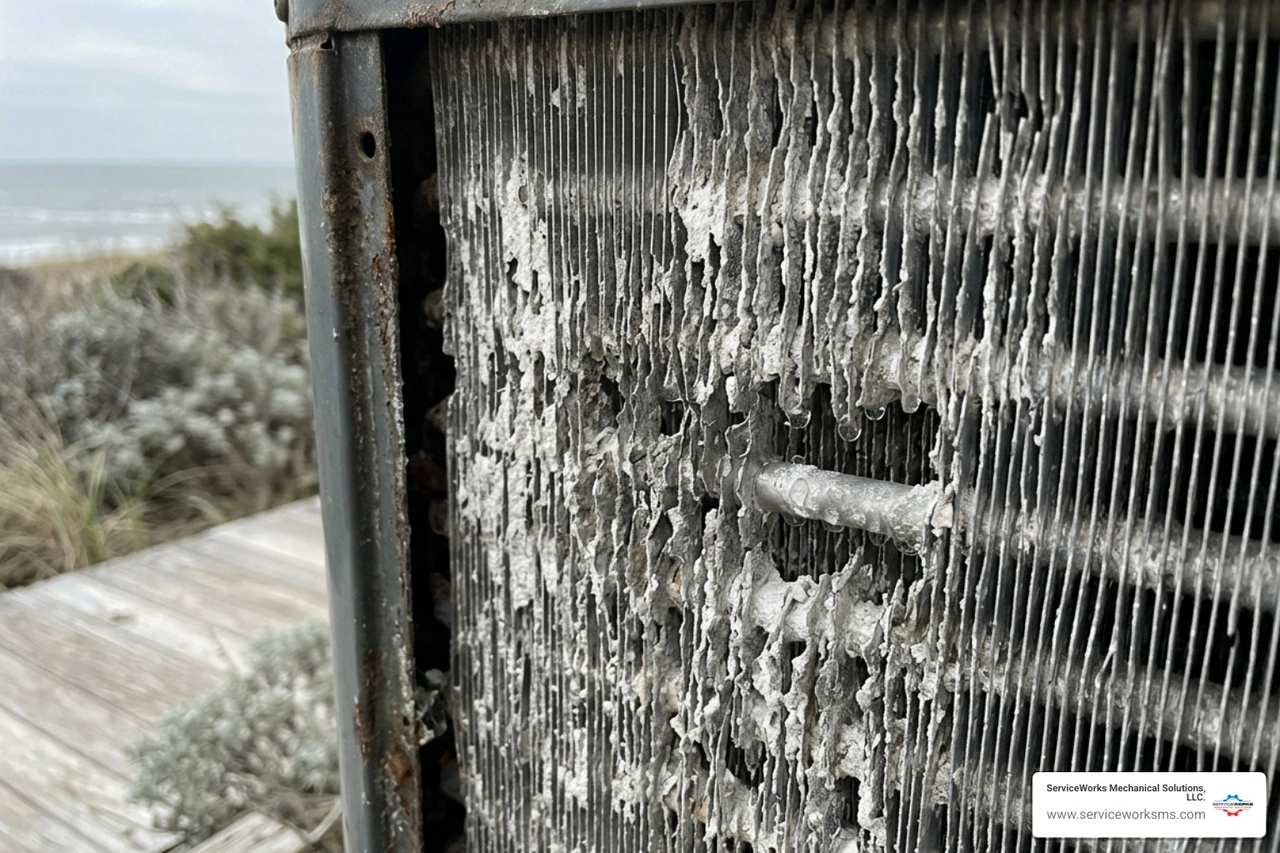
If you’ve ever noticed a white, powdery residue on your outdoor unit or seen the delicate metal fins on the back of your AC crumbling like old crackers, you’ve seen salt air corrosion in action. This isn't just a cosmetic issue; it's a chemical attack known as galvanic corrosion.
Salt particles from the Atlantic are carried miles inland by our coastal breezes. When these particles land on your outdoor condenser, they attract moisture. This creates a bridge between different types of metal—usually the aluminum fins and the copper tubing. This bridge allows a tiny electrical current to flow, which literally eats the metal away.
This process leads to:
- Reduced Heat Transfer: Corroded fins can't release heat efficiently, forcing the compressor to run longer and hotter.
- Refrigerant Leaks: As the copper lines degrade, microscopic pockmarks form, eventually leading to "mystery" refrigerant leaks that are difficult and expensive to fix.
- Total Component Failure: Salt air doesn't stop at the coils; it attacks the electrical contacts and the steel cabinet, leading to short circuits and structural failure.
Understanding how to extend the life of your AC on the coast requires a specialized strategy that homeowners in drier climates simply don't have to worry about.
How Coastal South Carolina Climate Affects Your HVAC Through Salt Air Corrosion
In Surfside Beach and surrounding areas, salt exposure is a 24/7 reality. We often see systems where the condenser coils have been eaten through in as little as five years. This accelerated wear is why we recommend specific signs your AC needs repair in coastal South Carolina, such as unusual grinding noises or a sudden spike in your monthly utility bill. These are often the first indicators that salt has compromised the mechanical integrity of your outdoor unit.
Managing Extreme Humidity and Latent Cooling Loads
In the Lowcountry, "it’s not the heat, it’s the humidity" isn't just a cliché—it’s a technical challenge for your HVAC. South Carolina’s coastal relative humidity routinely sits between 80% and 90%.
Your air conditioner has two jobs: sensible cooling (lowering the temperature) and latent cooling (removing moisture). In our climate, removing moisture can account for up to 50% of the total workload. When an AC removes moisture, that water has to go somewhere. On a typical July day in Myrtle Beach, an AC system can pull several gallons of water out of the air every single day. This puts an immense strain on your condensate drain lines. If these lines aren't maintained, they clog with algae and biofilm, leading to water damage in your ceilings or crawlspaces.
Furthermore, if your system is not properly sized using a Manual J load calculation, it may "short cycle." This means it cools the air too quickly and shuts off before it has a chance to actually dehumidify the home. This leaves you feeling "cool but clammy," which is a hallmark of how coastal south carolina climate affects your hvac performance.
How Coastal South Carolina Climate Affects Your HVAC Efficiency During High Humidity
High humidity doesn't just make you uncomfortable; it hits your wallet. In Climate Zone 3A, dehumidification can account for 40% of your cooling energy consumption. When the air is saturated with moisture, your system has to run for 30 to 40 minutes per cycle just to reach a comfortable dew point.
If your indoor humidity stays above 60%, you are also at risk for biological growth inside your ductwork and on your evaporator coil. This "dirty sock syndrome" or musty odor is one of the most common signs your AC needs repair in coastal South Carolina. To combat this, many of our neighbors in the Lowcountry find that adding a whole-home dehumidifier is the only way to maintain true comfort and protect their indoor air quality.
Essential Maintenance and Storm Readiness for the Lowcountry
Because the coastal environment is so aggressive, maintenance is a necessity, not a luxury. If you want your system to last longer than seven years, you have to be proactive.
The Coastal Maintenance Checklist:
- Salt Rinsing: Every few weeks during the summer, use a garden hose to gently rinse the salt deposits off your outdoor unit. (Note: Never use a pressure washer, as this will flatten the delicate fins).
- Filter Changes: In the Lowcountry, the "90-day filter" is a myth. During peak season, you should change your filters every 30 days to ensure maximum airflow and moisture removal.
- Coil Cleaning: Professional HVAC maintenance in Myrtle Beach, SC should include a chemical cleaning of the coils to remove the stubborn salt and "gunk" that a garden hose can't reach.
- Protective Coatings: When installing a new unit, we often recommend specialized corrosion-resistant coatings that provide an extra layer of defense against the salt air.
Is a HVAC maintenance plan worth it? For coastal residents, the answer is a resounding yes. Our Myrtle Beach HVAC maintenance agreement guide explains how regular check-ups can catch salt damage before it leads to a total system meltdown.
Storm Readiness:Living in a hurricane-prone area means your HVAC needs physical protection too.
- Hurricane Straps: Ensure your outdoor unit is bolted down to its pad.
- Elevation: In flood-prone areas like Socastee or Downtown Charleston, units should be elevated on stands to avoid storm surge damage.
- Surge Protection: Coastal storms often bring power fluctuations. A whole-house or unit-specific surge protector can save your compressor from an electrical "fried" circuit board.
Frequently Asked Questions about Coastal HVAC Care
Why does my Surfside Beach home feel humid even when the AC is running?
This is usually a sign of an oversized system or poor airflow. If the AC unit is too large for the square footage, it cools the room so fast that the thermostat shuts it off before the evaporator coil has time to pull the moisture out of the air. You end up with a house that is 72 degrees but 75% humidity—the "clammy" feeling. A dedicated dehumidifier or a variable-speed system can solve this.
How often should I rinse my outdoor unit if I live near the ocean?
If you live within a mile of the ocean (like many of our customers in Garden City or North Myrtle Beach), we recommend a gentle freshwater rinse every two to four weeks. This prevents salt crystals from bonding to the metal and starting the corrosion process.
Is it better to repair or replace a 10-year-old coastal AC system?
Inland, a 10-year-old system likely has five to ten years of life left. On the coast, a 10-year-old system is often nearing the end of its reliable lifespan. If you are facing a major repair (like a failed compressor or a leaking evaporator coil) on a decade-old coastal unit, replacement is often the smarter financial move. The salt has likely already compromised other components that will fail shortly after the repair.
Conclusion
Living in the Palmetto State is a dream, but the salt air and humidity don't take vacations. Understanding how coastal south carolina climate affects your hvac is the key to keeping your home a sanctuary rather than a source of stress.
At ServiceWorks Mechanical Solutions, LLC, we are a veteran-owned team that knows exactly what the Lowcountry elements can do to your equipment. Whether you are in Surfside Beach, Conway, or Summerville, we provide expert AC repair, maintenance, and installations backed by a 100% satisfaction guarantee. Don't let the salt air win the battle for your comfort.
Schedule your coastal HVAC inspection today and let us help you extend the life of your system for years to come.
testimonials
Customer Testimonials

With approved credit through Wisetack, you can enjoy zero down financing and convenient monthly payments, so you don’t have to wait to get the comfort you deserve.
Recent Blog
Stay updated with our latest blog posts.
Commercial Building Maintenance: The Real Cost of Putting Off Repairs
Guide