Why AC Units Near the Coast Wear Out Faster — And What It Means for Your Home
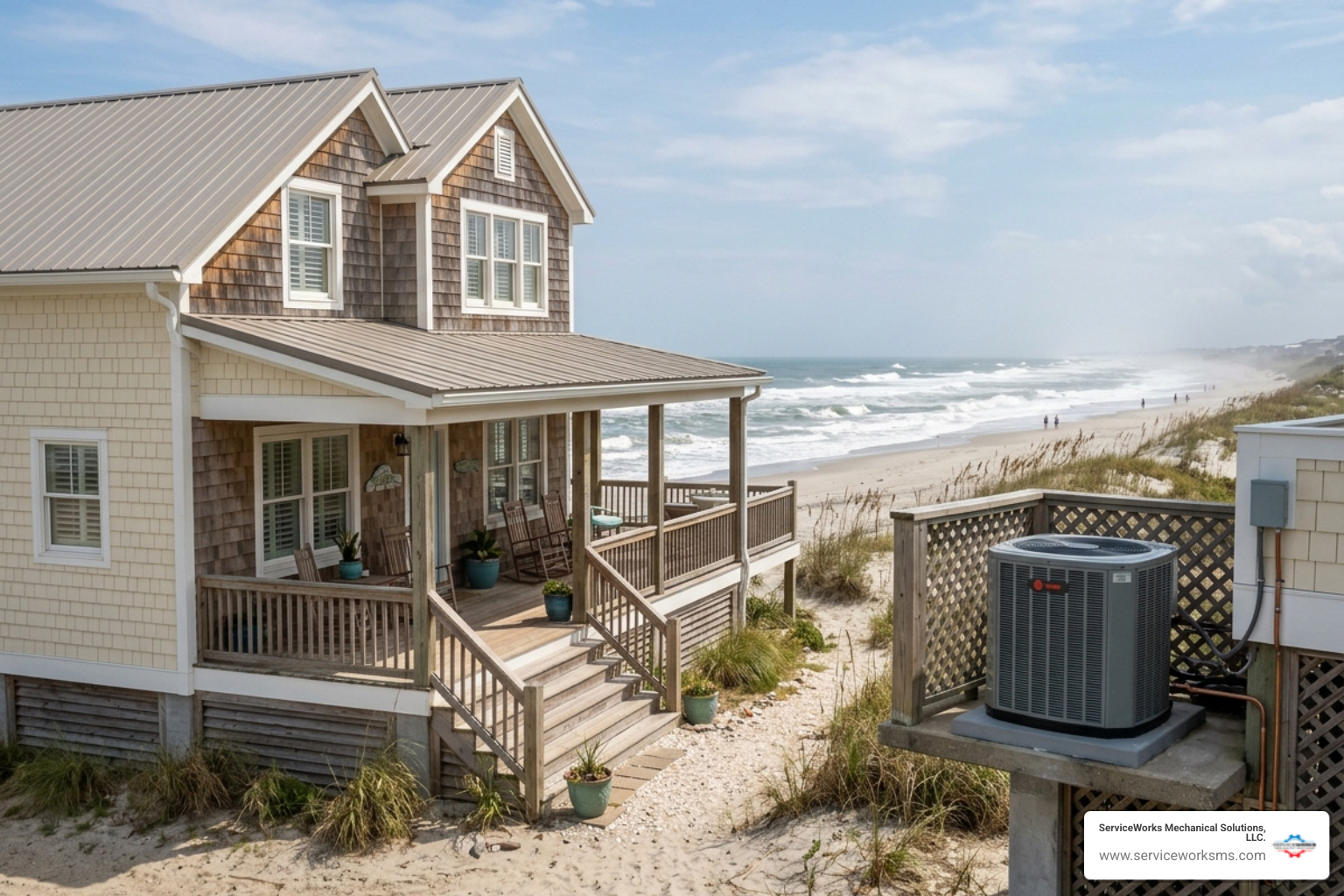
Why do ac units wear out faster near the coast comes down to one relentless force: salt air. In Surfside Beach, SC, every ocean breeze carries microscopic salt particles that land on your outdoor AC unit and quietly go to work. Salt is naturally corrosive. Combined with the high humidity and long cooling seasons common along the South Carolina coast, it creates conditions that can cut your AC's lifespan nearly in half compared to systems in inland states.
Here is a quick summary of the main reasons coastal AC systems age faster:
- Salt air corrosion — Airborne sodium chloride settles on metal components like condenser coils, fins, and electrical connections, triggering an electrochemical reaction that eats through metal 4 to 8 times faster than in dry, inland environments
- High humidity — Coastal air keeps metal surfaces constantly moist, which accelerates corrosion and forces your AC to work harder removing moisture from your home
- Long run times — Coastal systems in the South Carolina region can run 2,500 to 3,500 hours per year, compared to just 1,000 to 1,500 hours for systems in northern states, wearing out motors, compressors, and capacitors much sooner
- Sand and debris — Onshore winds push fine particles into the outdoor unit, clogging fins and restricting airflow
- Year-round operation — Unlike northern climates with a clear off-season, coastal systems rarely get a break, meaning continuous salt exposure with no recovery time
The result? While a standard AC unit is spec'd for a 12 to 15-year lifespan, coastal systems often show major wear by year 8 to 10 — and units located very close to the water can decline even sooner.
If you have lived near the Surfside Beach coastline for a few years, you may have already noticed your system running longer, working harder, or needing more frequent repairs. That is not bad luck. It is the predictable outcome of a harsh coastal environment doing what it does to unprotected metal and electrical components.
This guide breaks down exactly what is happening inside your AC unit, what warning signs to watch for, and what you can do — both on your own and with professional help — to get the most life out of your system.
Understanding Why do ac units wear out faster near the coast
To understand the lifespan of your cooling system, we have to look at the environment it lives in every day. In places like Myrtle Beach, Murrells Inlet, and Pawleys Island, the air isn't just humid; it’s chemically active. When we talk about why do ac units wear out faster near the coast, we are really talking about an accelerated aging process driven by sodium chloride (salt) and moisture.
Standard AC units are often built based on national averages that assume a relatively dry, salt-free environment. In those conditions, a unit might easily last 15 to 20 years. However, the South Carolina coast is a different world. According to ASTM B117 standards—the international benchmark for salt spray testing—corrosion can damage AC components 4 to 8 times faster in coastal environments than in inland areas.
| Feature | Coastal AC System (SC Coast) | Inland AC System (Arid/Midwest) |
|---|---|---|
| Typical Lifespan | 8–12 years (closer to ocean) | 15–20 years |
| Annual Run Time | 2,500–3,500 hours | 1,000–1,500 hours |
| Corrosion Rate | High (Electrochemical) | Low (Oxidation only) |
| Maintenance Needs | Quarterly/Semi-Annual | Annual |
| Primary Threat | Salt, Humidity, Sand | Dust, Pollen |
The Chemical Process: Why do ac units wear out faster near the coast?
The "science" part of this involves an electrochemical process. Salt is hygroscopic, meaning it attracts and holds onto water. When salt particles land on your AC’s aluminum fins and copper tubing, they create an "electrolyte" solution.
This moisture-salt combo triggers a "galvanic couple." Because aluminum is a "softer" or more reactive metal than copper, it essentially sacrifices itself to the corrosion. This leads to pitting corrosion, where tiny craters form in the aluminum fins. These fins are responsible for dissipating heat; as they turn into a powdery white substance and crumble, your AC loses its ability to cool your home, forcing the compressor to run hotter and longer until it eventually fails.
Proximity and Wind Patterns
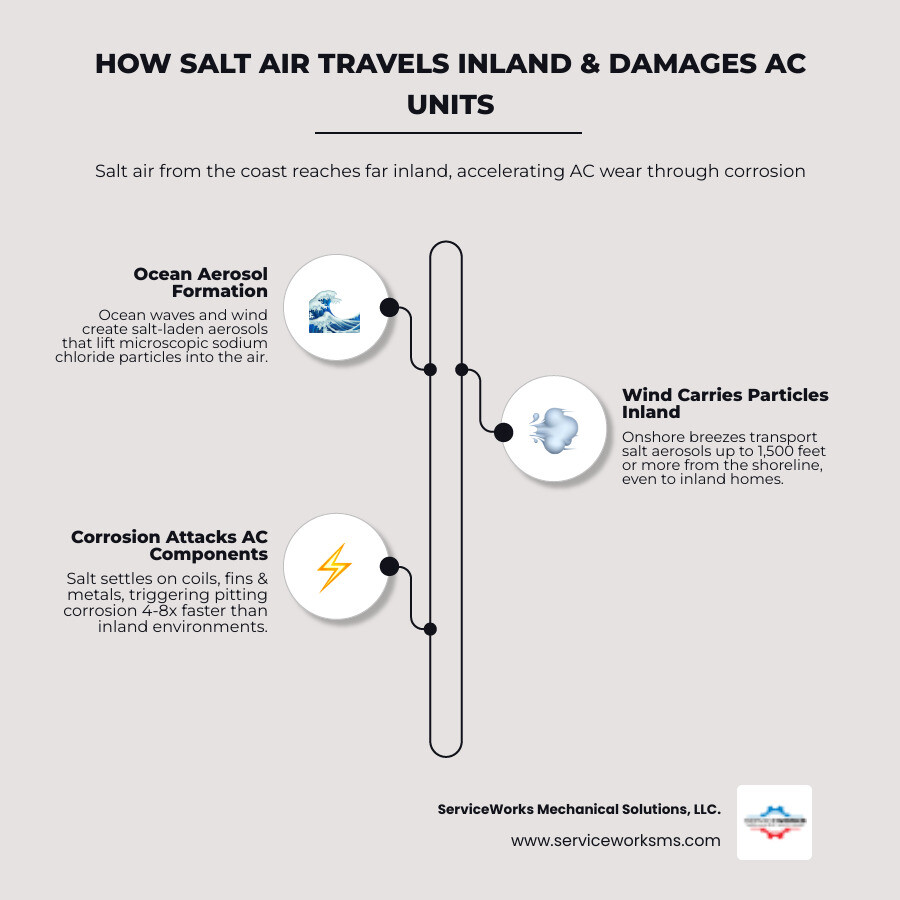
How close you live to the Atlantic Ocean or the marshlands of Georgetown and Little River matters immensely. Equipment installed within a 1,500-foot "high-exposure zone" of tidal water faces the highest concentrations of marine aerosols.
However, salt doesn't stop at the beach. Onshore breezes can carry these corrosive particles several miles inland. If your home is in Conway or Loris, you might think you’re safe, but those same winds also bring fine sand and salt that infiltrate the cabinet, trapping moisture against the metal and accelerating the breakdown of the protective oxide layer that normally keeps the metal safe.
How Salt Air and Humidity Damage Critical Components
When salt air gets inside your outdoor unit, it doesn't just sit there. It migrates into the most sensitive parts of the system. The most visible victim is the condenser coil. These coils are the "lungs" of your AC. As salt eats away at the fins, the surface area available for heat transfer disappears.
This creates a domino effect:
- Heat Transfer Reduction: The unit can't get rid of heat efficiently.
- Compressor Strain: To make up for the lost efficiency, the compressor works harder and gets hotter.
- Refrigerant Leaks: Corrosion eventually creates pinhole leaks in the copper or aluminum tubing, causing your system to lose its cooling charge.
- Electrical Shorts: Salt-laden moisture is conductive. It can bridge electrical gaps on control boards, leading to sudden shorts, component burnout, and intermittent failures that are frustrating to track down.
Identifying Damage: Why do ac units wear out faster near the coast?
We often see systems that look "aged" well before their time. If you want to know if the salt is winning the battle at your home, look for these specific warning signs:
- Flaking Fins: If you run a finger (carefully!) across the silver grids on your outdoor unit and they crumble like dry crackers or turn into white powder, corrosion is advanced.
- White Crusty Deposits: This is a sign of salt buildup and the early stages of aluminum pitting.
- Visible Rust: Check the base pan, fan motor housing, and the cabinet screws. If the factory powder coating is bubbling or orange rust is spreading, the structural integrity is being compromised.
- Unusual Rattling: As parts loosen due to rust or the fan motor becomes unbalanced from salt deposits, you’ll hear new, strange noises.
- Lukewarm Airflow: If the coils are too corroded to move heat, the air coming out of your vents won't feel as crisp and cold as it used to.
- Rising Energy Bills: A corroded system uses significantly more electricity to achieve the same level of cooling.
The Strain of High Humidity and Long Run Times
In Surfside Beach and the surrounding Grand Strand, our humidity levels regularly sit between 70% and 85%. Your AC has two jobs: lowering the temperature and removing moisture. In our climate, the dehumidification workload is massive.
A system in a northern state might run 1,000 hours a year. Here, your system might log 3,500 annual run hours. This constant operation means the metal components never truly dry out, which accelerates the electrochemical corrosion. Furthermore, high humidity leads to "algae biofilm" growth inside your condensate drain lines. In peak summer, an AC can pull a gallon of water per hour out of the air; if that line clogs due to coastal mold or algae, you’re looking at potential water damage inside your home.
Maintenance and Protection for Coastal Systems
While the coastal environment is tough, it isn't a death sentence for your air conditioner. With the right strategy, we can help you extend the life of your system significantly.
One of the most effective professional solutions is the application of coil coatings. Specialized treatments like phenolic epoxy or other marine-grade coatings provide a barrier between the metal and the salt air. These are best applied when a unit is new or during a deep professional cleaning.
Strategic placement also helps. If you are installing a new unit in a place like North Myrtle Beach, we often recommend placing it on the side of the house shielded from the predominant ocean winds or using a "windbreak" like a lattice fence to reduce direct aerosol spray.
DIY Care and Professional Service Intervals
You don't need a toolbox to help your AC last longer. The simplest tool you have is your garden hose.
- Freshwater Rinse: Once a week (or after a big storm), give your outdoor unit a gentle rinse with fresh water to wash away salt deposits. Important: Use a low-pressure stream. Never use a pressure washer, as it will flatten the delicate aluminum fins and destroy the unit.
- Vegetation Clearance: Keep plants and shrubs at least two feet away from the unit. This ensures proper airflow and prevents "micro-climates" of high moisture from forming around the cabinet.
- Professional Intervals: While inland homes might get by with an annual check-up, coastal homes in our service area—from Summerville to Little River—really need semi-annual tune-ups. We recommend a spring visit to prep for the heat and a fall visit to clear out the salt and sand accumulated during the peak season.
Features to Look for in Coastal-Rated Units
If it is time for an AC replacement in North Myrtle Beach, SC, don't just buy the cheapest standard unit. Look for "Coastal-Rated" features:
- Seacoast Coated Coils: Many manufacturers offer factory-applied epoxy or polymer coatings specifically for salt environments.
- Double Powder-Coated Cabinets: Extra layers of protection for the exterior housing.
- Stainless Steel Hardware: Prevents the screws and fasteners from rusting shut, making future repairs possible.
- Ductless Mini-Split Options: These systems often have smaller outdoor footprints and are engineered with high-durability components that handle salt well.
- High-Efficiency Ratings: Since coastal units run more hours, a higher SEER2 rating pays for itself much faster in energy savings.
Frequently Asked Questions about Coastal AC Wear
How much shorter is the lifespan of an AC unit near the coast?
On average, a coastal AC unit lasts about 8 to 12 years, whereas an inland unit might last 15 to 20 years. If you live directly on the oceanfront, that lifespan can drop to as little as 5 to 7 years without aggressive maintenance.
Can I use a standard cover to protect my AC from salt air?
Be very careful with covers. While they block salt, they often trap moisture and humidity inside the unit, which can actually speed up corrosion. If you use one, ensure it is a "breathable" marine-grade cover, and never run the AC while it is covered.
Does a standard manufacturer warranty cover salt air corrosion?
Generally, no. Most manufacturers consider salt air corrosion to be "environmental damage" or an "act of nature," similar to a flood or storm. This is why proactive maintenance and choosing coastal-rated equipment is so vital for homeowners in our area.
Conclusion
Living along the beautiful South Carolina coast is a dream, but it requires a different approach to home maintenance. Understanding why do ac units wear out faster near the coast is the first step in protecting your investment. Between the relentless salt, the thick humidity, and the thousands of hours your system works every year, your AC needs a partner to stay in the fight.
At ServiceWorks Mechanical Solutions, LLC, we bring veteran-owned discipline and local coastal expertise to every job. Whether you need a specialized coastal AC installation, a deep coil cleaning to remove salt buildup, or a 24/7 emergency repair in Surfside Beach, Charleston, or Columbia, we are here to ensure your home stays cool and your system lasts as long as possible.
Don't let the salt win. Schedule your coastal AC assessment today and let our licensed technicians give your system the protection it deserves.
testimonials
Customer Testimonials

With approved credit through Wisetack, you can enjoy zero down financing and convenient monthly payments, so you don’t have to wait to get the comfort you deserve.
Recent Blog
Stay updated with our latest blog posts.
Commercial HVAC Replacement Planning: How to Know When It’s Time to Replace Your System