
Guide
Why Conway, SC Homeowners Are Choosing Heat Pump Installation Now
Heat pump installation in Conway, SC is one of the smartest home comfort decisions you can make in Horry County's subtropical climate — where summers are long and hot, winters are short and mild, and your HVAC system works hard year-round.
Here's a quick overview of what you need to know:
- Best system types: Air-source, ductless mini-split, geothermal, and packaged heat pumps all work well in Conway
- Key efficiency ratings to look for: SEER 15–22+ for cooling, HSPF 8.5–13 for heating
- Energy savings: Modern heat pumps can cut heating costs by up to 50% compared to electric resistance heating
- Typical system lifespan: 10–15 years with proper maintenance
- Maintenance frequency: Twice per year (spring and fall) is recommended for year-round systems
- Signs you need a new system: Age over 10–15 years, rising energy bills, frequent breakdowns, or a unit still using R-22 refrigerant
If you're a Conway homeowner dealing with an aging system, unpredictable repair bills, or just want a more efficient way to stay comfortable through every season — a properly installed heat pump can solve all three problems at once.
Unlike a furnace or a standalone air conditioner, a heat pump handles both heating and cooling in one unit. It works by transferring heat rather than generating it through combustion, which means it produces more energy than it consumes — typically 3 to 4.5 units of heating or cooling for every unit of electricity used.
Conway's climate is actually ideal for this technology. Mild winters mean the system rarely needs to work at maximum heating capacity, and modern variable-speed units handle the region's high coastal humidity far better than older fixed-speed systems.
This guide walks you through everything — from choosing the right system and sizing it correctly, to what the installation process looks like, how to maintain it in a coastal environment, and when it makes sense to replace an older unit entirely.
Why Heat Pumps are the Perfect Fit for Conway’s Climate
Living in Conway means we are well-acquainted with the "Coastal South Carolina" experience: thick humidity in July and those "surprise" chilly snaps in January. Because our weather stays relatively moderate compared to the frozen North, we don't need a massive, combustion-based furnace to stay warm.
Heat pumps are the ideal solution because they provide dual-functionality. In the summer, they act exactly like a high-efficiency air conditioner, pulling heat out of your home. In the winter, they simply reverse the process. Even when it feels "cold" to us outside, there is still thermal energy in the atmosphere. The heat pump captures that heat and moves it indoors. This process is much more efficient than creating heat from scratch.
For many local residents, Heat Pump Service Conway SC is the most requested HVAC task because these systems are the workhorses of the Grand Strand. They offer superior humidity control and consistent temperatures without the need for a gas flue or venting, providing more flexibility for where the unit can be placed on your property.
Efficiency in Horry County Winters
While a traditional electric furnace uses "resistance heating" (think of a giant toaster), a heat pump uses electricity only to move heat. This results in a Coefficient of Performance (COP) of 3.0 to 4.5. In plain English, that means for every $1 you spend on electricity, you get $3 to $4.50 worth of heat.
Compared to electric resistance heating, a heat pump can reduce your heating costs by up to 50%. Even on the rare nights when temperatures dip toward freezing, modern units are designed to extract heat from the air efficiently. However, if your current system is struggling to keep up during a cold snap, you might actually need a Furnace Repair Conway SC or a check-up on your auxiliary heat strips to ensure you aren't overpaying for warmth.
Managing Coastal Humidity
In Conway, the humidity isn't just an outdoor problem; it can make your indoor air feel "heavy" and encourage mold growth if not managed. Modern heat pumps are masters of moisture removal. When we perform a heat pump installation in conway, sc, we often recommend variable-speed models.
Unlike older "on-or-off" systems, variable-speed units can run at lower speeds for longer cycles. This constant, gentle airflow allows the evaporator coil to pull significantly more moisture out of the air. If your home feels clammy even when the air is cool, it might be a sign that your system is short-cycling and needs a professional AC Repair Conway SC to recalibrate the dehumidification settings.
Choosing the Right System for Your Heat Pump Installation in Conway SC
Not every home in Conway is built the same. A historic home near Main Street has different needs than a new build in a sprawling subdivision. Choosing the right "flavor" of heat pump is the first step toward long-term comfort.
- Air-Source Heat Pumps: The most common type. These use an outdoor compressor and an indoor air handler connected by refrigerant lines.
- Ductless Mini-Splits: Perfect for room additions, converted garages, or older homes where adding ductwork is impossible. You can have multiple indoor units connected to one outdoor pump. For more on this, see our Mini Split Installation Conway SC guide.
- Geothermal Heat Pumps: These units use the stable temperature of the earth (via underground loops) to exchange heat. While the initial setup is more involved, they are incredibly efficient and can last 25 years or more.
- Packaged Systems: In these models, all components (compressor, coils, and fan) are housed in one outdoor cabinet. These are common for homes with limited indoor space or crawlspace-only access.
Understanding Efficiency Ratings: SEER and HSPF
When shopping for a new system, you’ll see two main acronyms: SEER (Seasonal Energy Efficiency Ratio) and HSPF (Heating Seasonal Performance Factor).
- SEER: Measures cooling efficiency. Modern units typically range from 15 to 22+. A high-end unit, like the Carrier Infinity 20, can reach 20.5 SEER.
- HSPF: Measures heating efficiency. You want to look for a rating between 8.5 and 13.0.
Why does this matter for your wallet? A unit with 16 SEER uses about 30% less energy than the 10 SEER units that were standard in homes built before 2006. If you are currently using an old system, a HVAC Replacement Conway SC could pay for itself in utility savings over just a few years.
| System Era | Typical SEER Rating | Energy Use Comparison |
|---|---|---|
| Pre-2006 | 10 SEER | Baseline (High Cost) |
| Modern Standard | 14-16 SEER | ~30% Less Energy |
| High Efficiency | 20+ SEER | ~50% Less Energy |
Advanced Technology for Heat Pump Installation in Conway SC
The "gold standard" in modern technology is adaptable-speed capability, such as Greenspeed Intelligence. This technology allows the heat pump to adjust its output in tiny 1% increments (usually between 40% and 100% capacity).
Instead of your system "blasting" on and then slamming off, it sips electricity and maintains a perfectly steady temperature. This leads to personalized comfort, quieter operation (some units run as quietly as 58 decibels), and lower wear and tear. When you opt for a Heat Pump Replacement Conway SC, choosing a smart, adaptive system ensures your home remains a sanctuary, regardless of the fluctuating South Carolina weather.
The Professional Installation Process and Sizing
One of the biggest mistakes a homeowner can make is assuming "bigger is better." In the HVAC world, an oversized heat pump is a disaster. It will turn on, cool the house too fast without removing humidity, and then turn off. This "short-cycling" kills the compressor and leaves you with a sticky, uncomfortable home.
Steps to a Successful Heat Pump Installation in Conway SC
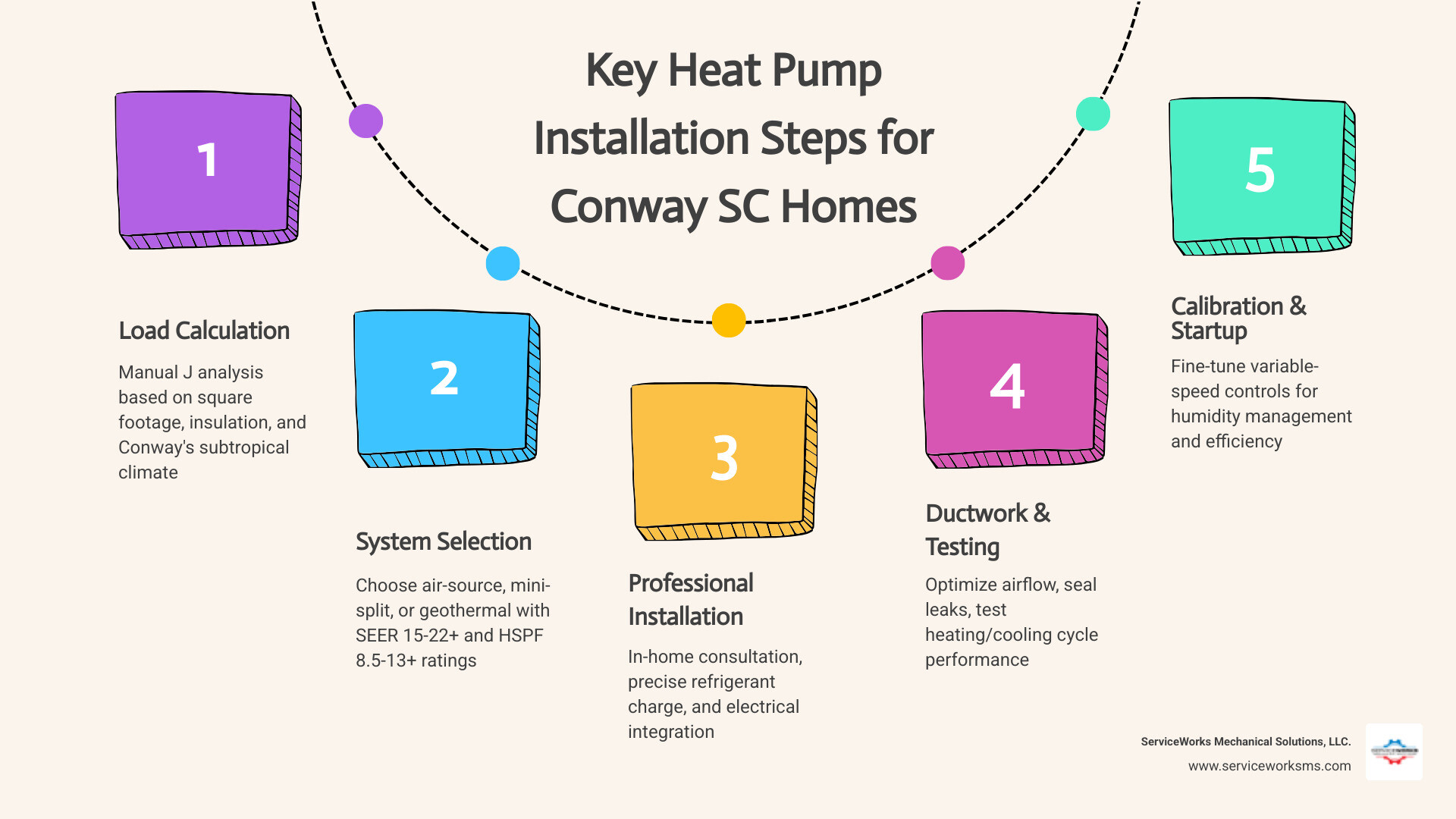
When we handle a heat pump installation in conway, sc, we follow a rigorous professional process:
- Load Calculation: We use "Manual J" software to calculate exactly how much heating and cooling your home needs. We look at square footage, insulation levels, window types, and even which way your house faces.
- In-Home Consultation: We discuss your comfort goals. Do you have hot spots? Allergies? We may recommend Duct Cleaning Conway SC to ensure your new system isn't pushing old dust through the house.
- Removal and Prep: We safely recover old refrigerant according to EPA guidelines and prepare the installation site, ensuring the outdoor unit is level and has proper clearance.
- Professional Installation: We connect the indoor and outdoor units, run new refrigerant lines if necessary, and handle any required Electrical Services Conway SC to ensure your panel can handle the new load.
- Testing and Calibration: We don't just flip a switch and leave. We test the refrigerant charge, check airflow, and calibrate the thermostat to ensure everything is running at peak efficiency.
Integrating Ductwork and Indoor Air Quality
A high-efficiency heat pump is only as good as the ducts it’s connected to. Did you know that leaky ductwork can account for up to 30% of your energy loss? If your ducts are whistling, dusty, or disconnected in the crawlspace, your new heat pump will have to work overtime.
During our HVAC Service Conway SC, we often inspect the duct integrity. We can also integrate indoor air quality (IAQ) solutions like air purifiers, whole-home dehumidifiers, or UV lights directly into your new system. This ensures that the air being circulated isn't just the right temperature, but is also clean and healthy for your family.
Maximizing Performance and Longevity in Coastal South Carolina
Conway’s proximity to the coast is great for weekend trips to the beach, but the salt air can be brutal on metal HVAC components. Without proper care, the outdoor coils can corrode, leading to refrigerant leaks and system failure.
When to Consider a Full System Replacement
Most heat pumps in our area have a lifespan of 10 to 15 years. You should consider a Heat Pump Installation Conway SC if you notice the following:
- The R-22 Factor: If your unit still uses R-22 (Freon), repairs are becoming astronomically expensive because this refrigerant has been phased out for environmental reasons.
- Frequent Breakdowns: If you've had to call for repairs more than twice in the last year, you're likely throwing "good money after bad."
- Rising Bills: If your utility bills are climbing but your habits haven't changed, your system is losing its efficiency.
- Age: If the unit is over 12 years old, it’s time to start planning. Check our Locations Conway SC page to see how we serve your specific neighborhood.
Preventing Common Operational Issues
Regular maintenance is the "secret sauce" to making a heat pump last. Because heat pumps run year-round (unlike a furnace that rests in summer), they need a check-up twice a year—once in the spring and once in the fall.
Common issues we prevent during a Furnace Tune Up Conway SC or heat pump inspection include:
- Icing Coils: Usually caused by restricted airflow (dirty filters) or low refrigerant.
- Reversing Valve Failure: This is the part that tells the unit whether to heat or cool. If it gets stuck, you're in for a very uncomfortable day.
- Thermostat Calibration: Sometimes the system is fine, but the "brain" is giving it the wrong instructions.
- Drain Line Clogs: High humidity means a lot of condensation. If the drain line clogs, it can back up and cause water damage to your home.
Frequently Asked Questions about Heat Pumps
How do heat pumps handle Conway's high humidity?
Modern heat pumps, especially those with variable-speed compressors, are excellent at dehumidification. By running longer, lower-intensity cycles, they pull more moisture out of the air than a standard AC unit, making your home feel much cooler at higher temperatures.
Can a heat pump replace both my furnace and air conditioner?
Yes! That is the primary benefit. A heat pump is a two-in-one system. It replaces your outdoor AC condenser and your indoor furnace/air handler, providing total climate control from a single system.
How long does a professional heat pump installation typically take?
A standard "change-out" (replacing an old unit with a new one) typically takes one full day (8–10 hours). If we need to modify ductwork or upgrade your electrical panel, it may take an additional day. We always strive to minimize downtime so your family stays comfortable.
Conclusion
Mastering your heat pump installation in conway, sc starts with choosing a partner who understands the local climate and the unique challenges of coastal living. At ServiceWorks Mechanical Solutions, LLC, we take pride in being a veteran-owned business that treats your home with the respect it deserves.
Whether you are looking for a high-efficiency upgrade like the Carrier Infinity series or need a versatile mini-split for a new addition, our team is here to help. We offer 24/7 emergency service and a 100% satisfaction guarantee, ensuring that when we install a system, it’s built to last.
Ready to upgrade your home comfort? Contact us today for expert Heat Pump Installation Conway SC and experience the difference that professional, local expertise makes.
testimonials
Customer Testimonials

With approved credit through Wisetack, you can enjoy zero down financing and convenient monthly payments, so you don’t have to wait to get the comfort you deserve.
Recent Blog
Stay updated with our latest blog posts.


Natural Gas vs. Propane: Which Is Best for Your Myrtle Beach Home?