Guide
Is Your AC Compressor Failing? Here's How to Tell Before It Breaks Down
How to tell if your AC compressor is failing is one of the most important things a Surfside Beach, SC homeowner can learn — especially when summer heat and coastal humidity put your system under serious stress. The compressor is the heart of your AC system. When it starts to go, your whole home pays the price.
Here are the most common warning signs to watch for:
- Warm air blowing from vents even when the AC is running
- Unusual noises from the outdoor unit — grinding, hissing, clanking, or clicking
- Frequent circuit breaker trips when the AC tries to start
- Short cycling — the system turns on and off more than normal
- Higher energy bills without a change in usage
- Visible refrigerant leaks or ice forming around the outdoor unit
- Reduced airflow throughout the home
Most AC compressors last 10 to 15 years with proper maintenance. But in coastal South Carolina, salt air, high humidity, and heavy seasonal use can wear a compressor down faster than average. Catching the early warning signs can be the difference between a simple repair and a full system replacement.
One homeowner's story says it all: a subtle grinding sound was ignored for weeks — until the system failed completely during a weekend heatwave, requiring a full compressor replacement that could have been avoided with earlier action.
The sections below break down each warning sign in detail, explain what causes them, and help you decide when it's time to call a licensed HVAC technician.
Understanding the Role of Your AC Compressor
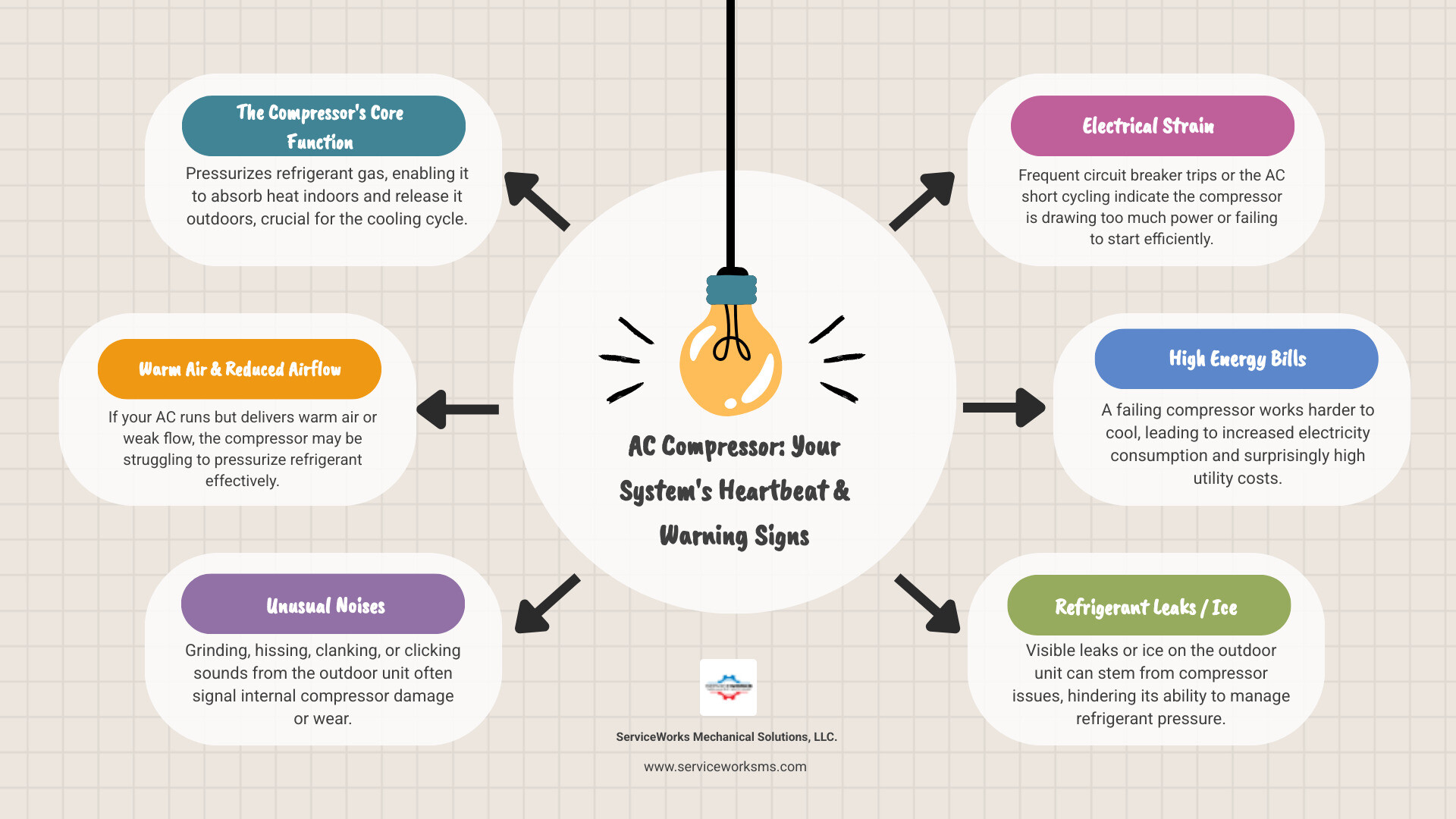
Think of your air conditioner as a team, and the compressor as the star player. Located within the outdoor unit (the condenser), the compressor is responsible for circulating refrigerant throughout the entire system. Its primary job is to take low-pressure, cool refrigerant gas and squeeze it into a high-pressure, high-temperature gas.
This pressurization is vital for heat transfer. By increasing the pressure, the compressor allows the refrigerant to release the heat it absorbed from inside your home as it passes through the outdoor coils. Once the heat is dumped outside, the refrigerant cools down, turns back into a liquid, and heads back indoors to start the process all over again.
Without a functional compressor, the refrigeration cycle stops. The fans might still blow, and the thermostat might still click, but no actual cooling will occur. Because the compressor works under immense pressure and handles high-voltage electricity, it is often the most stressed component in your Air Conditioning Services lineup. Understanding how to tell if your AC compressor is failing starts with respecting just how hard this "heart" of the system works to keep you comfortable in the South Carolina humidity.
7 Warning Signs: How to Tell if Your AC Compressor is Failing
Detecting a problem early can save you from a total system breakdown in the middle of a July heatwave. Here are the seven most common indicators that your compressor is on its last legs.
1. Warm Air Blowing from Vents
If you feel lukewarm or warm air coming from your supply registers, your compressor may no longer be able to pump refrigerant effectively. While this can also be caused by a blown fuse or a dirty air filter, it’s a classic sign that the compressor isn't pressurizing the gas enough to facilitate heat exchange.
2. Reduced Airflow
When a compressor begins to struggle, you might notice that the air coming out of the vents feels "weak." If the compressor isn't moving refrigerant at the correct rate, the cooling process becomes inefficient, leading to poor airflow and hot spots in your home. This is often one of the 5 Common Signs Your Myrtle Beach Home Needs AC Repair.
3. Refrigerant Leaks
The compressor relies on a specific amount of refrigerant (called a "charge") to operate. If you see colorful stains or puddles around the base of your outdoor unit, or if you notice ice forming on the copper lines, you likely have a leak. Low refrigerant levels force the compressor to work twice as hard, leading to overheating and eventual failure.
4. Moisture and Puddles
While some condensation is normal, actual liquid refrigerant leaks are a major red flag. If the compressor seals are worn or the lines are corroded by salt air, the system will lose its ability to cool.
5. Skyrocketing Energy Bills
Is your electric bill suddenly much higher than it was in April 2025? A failing compressor often runs for longer cycles and consumes more power as it struggles to reach the temperature set on your thermostat.
6. Short Cycling
If your AC turns on for three minutes, shuts off, and then turns back on again shortly after, it’s "short cycling." This puts massive strain on the compressor's motor and is often a sign of internal overheating or pressure imbalances.
7. Shaking or Vibrating on Startup
If the outdoor unit visibly shakes or "jumps" when it kicks on, the compressor is likely experiencing a "hard start." This indicates that the motor is struggling to overcome the internal pressures of the system.
| Symptom | Normal Operation | Potential Compressor Failure |
|---|---|---|
| Vent Temperature | Crisp, cold air (approx. 15-20° drop) | Room temperature or lukewarm air |
| Outdoor Noise | Steady, low hum of the fan | Grinding, clattering, or loud clicking |
| Electrical | Smooth start without flickering lights | Frequent tripped breakers or dimming lights |
| System Cycle | Runs for 15-20 mins to reach temp | Turns on/off every few minutes (Short cycling) |
| Exterior Unit | Dry or light condensation on pipes | Ice buildup or oily refrigerant puddles |
Unusual Noises and How to Tell if Your AC Compressor is Failing
A healthy AC unit should be relatively quiet, with the most noticeable sound being the whir of the condenser fan. When the compressor starts to fail, it often "screams" for help through various mechanical noises.
- Grinding or Screeching: This usually points to worn-out bearings or internal metal components rubbing together. If you hear this, shut the system off immediately. Metal-on-metal contact can send debris through your entire system, ruining the coils and expansion valves.
- Clattering or Rattling: This often indicates that a mount has come loose or that internal parts of the compressor motor have broken off and are bouncing around inside the sealed housing.
- Hissing: A hissing sound is a tell-tale sign of a refrigerant leak, specifically from the compressor's seals or valves.
- Clicking: If you hear a repetitive clicking when the system tries to start, the compressor may be struggling to engage. This is often an electrical issue or a failing capacitor.
If your unit is making any of these sounds, it's time to call for AC Repair Myrtle Beach SC. Ignoring these sounds will only lead to a more expensive repair bill later.
Electrical Issues: How to Tell if Your AC Compressor is Failing
The compressor is the largest consumer of electricity in your home. When it starts to fail, it often creates electrical anomalies that you can see and feel.
Tripped Circuit BreakersThe circuit breaker is a safety device. If your compressor is failing, it may "lock up" or overheat, causing it to pull an excessive amount of Amps. This surge in current trips the breaker to prevent a house fire. If you find yourself resetting the AC breaker more than once, do not flip it back on. Call a professional immediately.
Hard Starting and Dimming LightsHave you noticed the lights in your living room flicker or dim for a split second when the AC kicks on? This is a sign of "hard starting." The compressor is pulling so much power to get moving that it’s starving the rest of your home’s circuits. This often precedes a total motor burnout.
Capacitor FailureSometimes, the compressor itself is fine, but the "start capacitor" (which acts like a battery to give the motor a boost) has failed. However, a bad capacitor can quickly lead to a bad compressor if the motor is forced to try and start without that extra help. For urgent situations, we provide Emergency AC Repair in Grand Strand Area to diagnose these electrical gremlins before they kill your compressor.
Why Coastal South Carolina Homeowners Face Unique Compressor Challenges
Living in Surfside Beach, Myrtle Beach, or Charleston is a dream, but the environment is tough on HVAC equipment. We face three specific enemies:
- Salt Air Corrosion: The salt in our coastal air is highly corrosive. It eats away at the aluminum fins and copper headers of your outdoor unit. When these coils degrade, the compressor has to work at much higher pressures to dissipate heat, leading to premature failure. This is why reading an AC Repair Charleston SC Complete Guide is so useful for locals.
- High Humidity: Our humidity levels mean the AC has to run longer to dehumidify the air. More "run time" means more wear and tear on the compressor's internal valves.
- Sand Accumulation: Wind-blown sand can clog the condenser coils. A clogged coil is like trying to run a marathon while breathing through a straw; the compressor will overheat and eventually seize.
Repair vs. Replacement: Making the Right Choice for Your Home
When you find out your compressor is failing, the big question is: do I fix it or replace the whole unit?
When to Repair:
- The unit is less than 10 years old.
- The compressor is still under the manufacturer's warranty.
- The issue is external, such as a bad capacitor, a contactor, or a simple refrigerant leak.
- You are in a location like Seven Oaks and need a quick AC Repair Seven Oaks SC to get through a heatwave.
When to Replace:
- The unit is 10-15 years old. In the coastal South Carolina climate, 12 years is often the "sweet spot" where replacement becomes more economical.
- The compressor has an internal mechanical failure (the "heart" has stopped).
- The cost of the compressor replacement is more than 50% of the cost of a new, high-efficiency SEER2 system.
- The system uses R-22 refrigerant (an older, phased-out type that is very expensive to refill).
Replacing an old, struggling unit with a new energy-efficient model can often pay for itself over time through lower monthly utility bills and the peace of mind that comes with a new 10-year warranty.
Preventive Maintenance to Extend Your Compressor's Lifespan
The best way to handle a failing compressor is to prevent it from failing in the first place. Maintenance is the key to longevity.
- Change Your Filters Monthly: A dirty filter restricts airflow, causing the indoor coil to freeze and sending liquid refrigerant back to the compressor (which is only designed to handle gas). This is known as "slugging" and it kills compressors fast.
- Keep the Outdoor Unit Clear: Ensure there are at least two feet of clearance around your condenser. Trim back bushes and remove any beach chairs or toys leaning against the unit.
- Clean the Coils: Gently rinse your outdoor coils with a garden hose (not a pressure washer!) to remove salt and sand. For a deeper clean, follow an AC Maintenance Charleston SC Guide.
- Schedule Annual Tune-Ups: A professional AC Tune-Up Goose Creek SC includes checking refrigerant levels, tightening electrical connections, and testing the compressor's "amp draw." Catching a small electrical issue today prevents a dead compressor tomorrow.
For comprehensive care, our AC Service & Maintenance Myrtle Beach SC plans are designed specifically for the unique needs of coastal homes.
Frequently Asked Questions about AC Compressor Failure
How long does a typical AC compressor last in coastal SC?
While the national average is 10-15 years, the salt air and high heat in areas like Surfside Beach and Murrells Inlet often mean compressors last closer to 8-12 years. Regular maintenance is the only way to push that number toward the 15-year mark.
Can I continue to run my AC if I suspect the compressor is failing?
We strongly advise against it. If the compressor is making grinding noises or tripping the breaker, continuing to run it can cause a "burnout." This releases acid and soot into your refrigerant lines, which can ruin a brand-new compressor if you try to replace it later without an expensive system flush.
Is a refrigerant leak always a sign of a bad compressor?
Not necessarily. A leak can occur in the indoor evaporator coil or the copper lines. However, running a system that is low on refrigerant will eventually cause the compressor to overheat and fail. If you suspect a leak, shut down the system and call us for an inspection.
Conclusion
Your air conditioner's compressor is a rugged piece of machinery, but it isn't invincible. By knowing how to tell if your AC compressor is failing, you can take action while the problem is still manageable. Whether you're in Myrtle Beach, Conway, or Summerville, keeping an ear out for strange noises and an eye on your energy bills is the best way to protect your home comfort.
At ServiceWorks Mechanical Solutions, LLC, we are a veteran-owned team dedicated to keeping South Carolina families cool. We provide expert, licensed HVAC services with a 100% satisfaction guarantee. From routine maintenance to emergency replacements, our technicians have the local expertise to handle the coastal climate's toughest challenges.
Don't wait until the SC heat becomes unbearable. If you've noticed any of the warning signs mentioned in this guide, contact our team for professional Air Conditioning Services today. We’ll help you determine if a simple repair can save your compressor or if it’s time for a more efficient upgrade.
testimonials
Customer Testimonials

With approved credit through Wisetack, you can enjoy zero down financing and convenient monthly payments, so you don’t have to wait to get the comfort you deserve.
Recent Blog
Stay updated with our latest blog posts.

Natural Gas vs. Propane: Which Is Best for Your Myrtle Beach Home?