Guide
Why Knowing When Should You Replace Your AC in a Coastal Climate Can Save You From a Costly Breakdown
Knowing when should you replace your AC in a coastal climate is one of the most important decisions you can make as a homeowner in Surfside Beach, SC. The salt air rolling in off the Atlantic, combined with relentless humidity and long cooling seasons, puts your system under stress that inland homeowners simply never face.
Here is a quick answer before we dive deeper:
Replace your coastal AC when:
- Your system is 10 to 15 years old (or as young as 8 to 12 years if you live within a mile of the ocean)
- A repair estimate exceeds 30 to 50% of the cost of a new system
- Multiplying your system's age by the repair cost exceeds $5,000 (the "$5,000 Rule")
- You notice rising energy bills, uneven cooling, or persistent indoor humidity
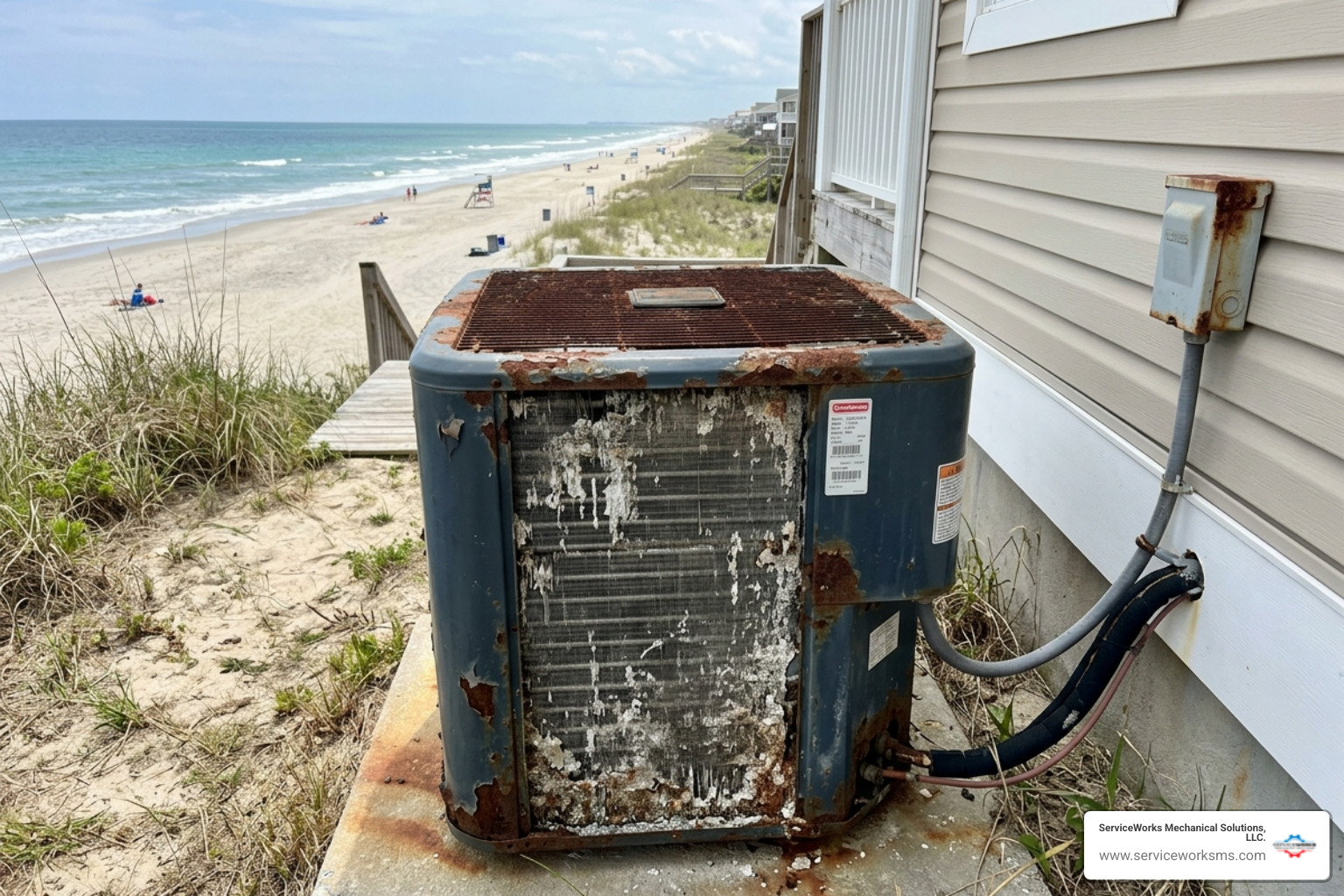
- There is visible rust or corrosion on the outdoor unit
- You are experiencing more than one breakdown per year
Salt air corrodes metal components two to three times faster than in dry inland climates. That means a system that might last 15 to 20 years in a northern state may only survive 10 to 15 years here on the South Carolina coast — and even less if your home sits close to the water. Coastal AC systems also log far more operating hours per year than their inland counterparts, simply because the heat and humidity demand near-constant dehumidification. That extra runtime adds up fast, wearing down motors, compressors, and electrical components well ahead of schedule.
If your beach house AC is getting up in years and repair calls are becoming a regular occurrence, it is worth taking a closer look at whether you are keeping a struggling system on life support — or whether it is time to move on.

How Salt Air and Humidity Shorten HVAC Lifespan
Living on the South Carolina coast means our HVAC systems are essentially living in a "slow-motion battery." When salt particles from the ocean breeze settle on your outdoor unit and combine with our high humidity, an electrolytic reaction occurs. This chemical process is incredibly aggressive, eating away at the vital components of your air conditioner.
The most vulnerable parts are the aluminum fins and copper tubing within the condenser coil. As salt accumulates, it causes the metal to pit and flake. This isn't just a cosmetic issue; it's a major performance killer. These fins are designed to disperse heat; when they corrode, they lose their ability to transfer heat effectively. In fact, research shows that salt corrosion can reduce an AC system’s efficiency by up to 30% over time.
When the system can't breathe or shed heat, the compressor has to work twice as hard to reach your thermostat's target temperature. This leads to higher energy consumption and frequent needs for AC Repair North Myrtle Beach SC as internal parts begin to fail under the strain.
Proximity to the Ocean and System Runtime
The closer you are to the Grand Strand, the higher the "salt load" on your equipment. Homes located within a one-mile radius of the ocean experience the most aggressive salt exposure. However, even if you are a few miles inland in places like Conway or Socastee, onshore breezes can still carry those corrosive particles straight to your backyard.
In addition to salt, we have to deal with extreme runtime. In a northern state, a well-maintained AC might run for 1,000 to 1,500 hours per year. Here in coastal South Carolina, our systems often log between 2,500 and 3,500 hours annually. This is because our air conditioners aren't just cooling the air; they are working overtime to remove moisture. With relative humidity levels often hovering between 70% and 85%, your AC is essentially a giant dehumidifier. If you feel like your system is struggling, a professional AC Tune Up Charleston SC can help assess if the runtime is within healthy limits or if the system is nearing its end.
| Factor | Coastal SC System | Inland/Northern System |
|---|---|---|
| Annual Runtime | 2,500 – 3,500 Hours | 1,000 – 1,500 Hours |
| Corrosion Rate | 2x – 3x Faster | Standard |
| Humidity Load | Extremely High | Low to Moderate |
| Avg. Lifespan | 10 – 15 Years | 15 – 20 Years |
Signs of Accelerated Component Failure
How do you know if the salt air is winning the battle? There are several physical warning signs that indicate your system is failing prematurely:
- Pitted or Crumbling Coils: If you look at the silver fins on your outdoor unit and they look like they are turning into white powder or falling off at the touch, the corrosion is advanced.
- Rusted Electrical Terminals: Salt and moisture can cause electrical shorts in control boards or corrode wire terminals, leading to intermittent failures.
- Fan Motor Failure: Corrosion can freeze blower motor bearings or cause the fan blades to become unbalanced.
- Refrigerant Leaks: As the copper tubing thins due to pitting, tiny "formicary" leaks develop, which are often difficult and expensive to patch.
If you are noticing any of these, it is wise to review the 5 Common Signs Your Myrtle Beach Home Needs AC Repair Before Summer Hits to see if a simple fix will do or if the damage is too extensive.
When Should You Replace Your AC in a Coastal Climate?
As of April 2026, the technology for coastal protection has improved, but the laws of chemistry haven't changed. The realistic lifespan for an AC system in coastal South Carolina remains closer to 10 to 15 years. If your unit is located directly on the oceanfront, you might only get 8 to 12 years of reliable service before major failures occur.
Proactive planning is the key to avoiding a "no-AC emergency" in the middle of a July heatwave. Waiting for a catastrophic compressor failure often means you’ll be forced to make a rushed decision based on whatever unit is in stock, rather than choosing the most efficient and protected model for your home. Investing in a timely AC Replacement Myrtle Beach SC ensures your family stays comfortable and your energy bills stay manageable.
Identifying When Should You Replace Your AC in a Coastal Climate Based on Age
While the national average for a central air conditioning system is often cited as 15 to 20 years, that number is a myth in places like Little River or Murrells Inlet. By the time a coastal system hits the 10-year mark, it has already logged the equivalent of 20 years of "inland hours."
If your system is nearing a decade in age, you should start budgeting for its successor. Furthermore, older systems often use obsolete refrigerants like R-22, which are no longer produced and are incredibly expensive to recharge. Even systems using R-410A are seeing changes in availability as newer, more eco-friendly refrigerants take over. If you are facing a major repair on a 12-year-old unit, an AC Replacement Little River SC is almost always the smarter financial move.
Performance Indicators for Retirement
Age isn't the only factor. Your home will often tell you when the system is ready for retirement:
- Rising Utility Bills: If your electric bill keeps climbing even though your usage habits haven't changed, your system has likely lost its efficiency due to coil degradation.
- Uneven Cooling: Are some rooms ice-cold while others feel like a sauna? This often indicates a failing compressor or a system that can no longer maintain the proper pressure.
- Persistent Indoor Stickiness: If your home feels "clammy" or humid even when the AC is running, the system is no longer effectively removing moisture.
- Unusual Odors or Noises: Grinding sounds from the outdoor unit or "dirty sock" smells from the vents are signs of mechanical failure or biological growth on the evaporator coil.
If these issues sound familiar, scheduling AC Service Maintenance Columbia SC can provide a professional diagnosis, but be prepared for the technician to suggest it’s time to plan for a new unit.
Repair vs. Replace: The $5,000 Rule for Coastal Homeowners
Deciding whether to sink more money into an old unit or invest in a new one is the most common dilemma we see. To make it easier, we recommend using a few industry standard guidelines.
The most popular is the $5,000 Rule. You simply multiply the age of your AC system by the estimated repair cost. If the total is over $5,000, replacing the system is typically the smarter investment. For example, if you have a 10-year-old system facing a $600 repair, that equals $6,000—signaling it's time to retire the unit.
Another guideline is the 50% Rule: If a repair costs 50% or more of what a new system would cost, you should always replace it. In coastal areas, we often suggest being even more conservative; if the system is over 8 years old and a repair costs more than 30–40% of a replacement, it is usually better to put that money toward a new AC Installation Surfside Beach SC.
Calculating When Should You Replace Your AC in a Coastal Climate
When you calculate the return on investment (ROI) for a new system, don't just look at the repair bill. Consider the long-term savings. A modern, high-efficiency system can reduce your monthly cooling costs by 20% to 40% compared to a decade-old unit that has been ravaged by salt air.
Newer units also offer superior humidity control, which protects your home's structure, prevents mold, and allows you to feel comfortable at a slightly higher thermostat setting. When you add up the energy savings, the lack of repair bills, and the increased home value, an AC Installation Myrtle Beach SC often pays for itself within just a few years.
Essential Features for Your Next Coastal-Rated AC Unit
If you are buying a new AC for a beach house, you cannot just buy a "standard" unit off the shelf. You need equipment designed to survive the salt. Look for these specific features:
- Specialized Coil Coatings: Technologies like e-coating (electro-coating) or phenolic coatings provide a protective barrier over the aluminum fins. These coatings can add years to the life of a system by preventing salt from ever touching the metal.
- Corrosion-Resistant Fasteners: Ensure the unit uses stainless steel or specially coated screws and bolts so the cabinet doesn't rust apart.
- SEER2 Efficiency: As of 2026, SEER2 is the standard. Choosing a higher rating ensures lower bills and better performance in our 95°F+ summers.
- Humidity Control Technology: Variable-speed blowers are excellent for coastal homes because they run at lower speeds for longer periods, pulling more moisture out of the air than a standard "on/off" system.
When we perform an AC Installation Georgetown SC, we always discuss these coastal-specific upgrades to ensure your investment is protected from the day it's installed.
Extending System Life Through Coastal Maintenance
Even the best coastal-rated system needs help. You can significantly extend the life of your AC with a few simple habits:
- Monthly Fresh Water Flush: Every month during the cooling season, take a garden hose and gently rinse the outdoor condenser unit. This washes away salt deposits before they can start the corrosion process. (Note: Turn off the power at the disconnect first and avoid using a pressure washer, which can bend the delicate fins).
- Semi-Annual Professional Service: Inland systems can get away with annual service, but coastal systems need a check-up twice a year. Scheduling AC Maintenance Murrells Inlet SC ensures that drain lines are clear of algae and that electrical components are free of salt-induced corrosion.
- Filter Changes: Change your filters every 30 to 60 days. In our humid climate, dirty filters lead to frozen coils and massive strain on the blower motor.
- Clearance: Maintain at least two feet of clearance around your outdoor unit. Trim back sea grass, bushes, and remove any debris that might block airflow.
- Sacrificial Anodes: Much like on a boat motor, some coastal systems can be fitted with sacrificial anodes that "sacrifice" themselves to corrosion to protect the more expensive metal parts of your AC.
Frequently Asked Questions about Coastal AC Replacement
How much faster does salt air corrode an AC unit?
Salt air accelerates corrosion on metal components at rates two to three times faster than in dry, inland climates. This leads to restricted airflow, reduced efficiency, and eventually, total component failure. Without protection, a unit can show significant degradation in as little as 3 to 5 years.
Does proximity to the beach affect my warranty?
It can. Many manufacturers have specific "coastal clauses" in their warranties. Some may require proof of regular professional maintenance or specific coatings to honor corrosion-related claims. Always keep your service documentation and ask your installer about warranty exclusions for homes within a certain distance of the ocean.
Can I protect my current unit from salt damage?
Yes. Beyond regular rinsing, you can have a professional apply anti-corrosion sprays or treatments to the coils. Installing windbreaks (that still allow for proper airflow) can also reduce the amount of direct salt spray that reaches the unit.
Conclusion
At ServiceWorks Mechanical Solutions, LLC, we understand the unique challenges of living on the South Carolina coast. As a veteran-owned company based in Surfside Beach, we’ve seen how the Atlantic air can turn a high-end air conditioner into a pile of rust in record time. Whether you are in Pawleys Island, Florence, or Loris, our goal is to ensure your home remains a sanctuary of comfort.
If you are questioning when should you replace your AC in a coastal climate, don't wait for the heat of July to find out the answer. From proactive maintenance to expert AC Replacement North Myrtle Beach SC, we are here to provide reliable, high-efficiency cooling solutions tailored to our beautiful but demanding environment.
Ready to evaluate your system? Contact ServiceWorks Mechanical Solutions, LLC today for a professional assessment and ensure your beach house stays cool for years to come.
testimonials
Customer Testimonials

With approved credit through Wisetack, you can enjoy zero down financing and convenient monthly payments, so you don’t have to wait to get the comfort you deserve.
Recent Blog
Stay updated with our latest blog posts.
Natural Gas vs. Propane: Which Is Best for Your Myrtle Beach Home?