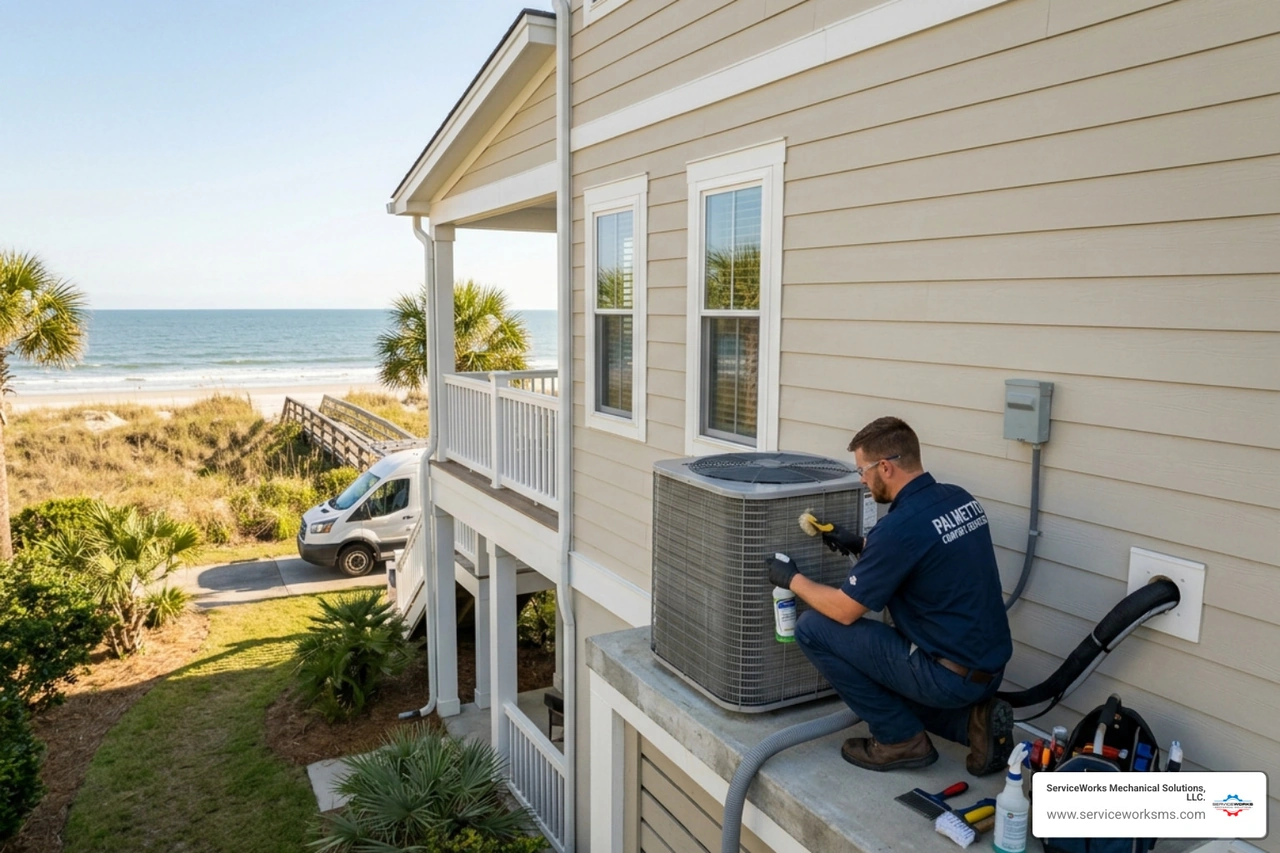
Why Mold-Free Air Starts With Your HVAC System in Surfside Beach, SC
How proper HVAC maintenance prevents mold growth is one of the most important things Surfside Beach, SC homeowners can understand — especially along the South Carolina coast, where warm temperatures and high humidity create near-perfect conditions for mold to take hold inside your home's heating and cooling system. Mold spores are always present in the air around us. They become a real problem the moment they land on a damp surface inside your ducts, on your evaporator coils, or in your condensate drain pan — and that can happen faster than most people expect.
Here's a quick summary of how proper HVAC maintenance keeps mold out of your home:
- Change air filters every 30–90 days to prevent dust and moisture buildup that feeds mold growth
- Keep indoor humidity between 30–50% using your AC system and, when needed, a dehumidifier
- Clean condensate drain lines regularly to prevent standing water from forming inside your unit
- Schedule professional HVAC inspections twice a year — before cooling season and before heating season — to catch moisture issues early
- Seal leaky ductwork to stop humid outdoor air from entering your system and triggering condensation
- Clean evaporator coils and drain pans to remove the organic buildup that mold feeds on
- Consider UV lights or high-efficiency MERV 8–13 filters for an added layer of mold spore control
When any of these steps are skipped, moisture builds up inside your system. According to research from the EPA, indoor relative humidity above 60% creates conditions where mold thrives — and mold colonies can begin forming within just one to two days once moisture and a food source are present. In a coastal climate like Surfside Beach, that risk is elevated year-round.
The good news? Consistent, routine HVAC care is the single most effective way to stop mold before it starts — protecting your health, your home's air quality, and the life of your equipment.
Understanding the Science: How Proper HVAC Maintenance Prevents Mold Growth
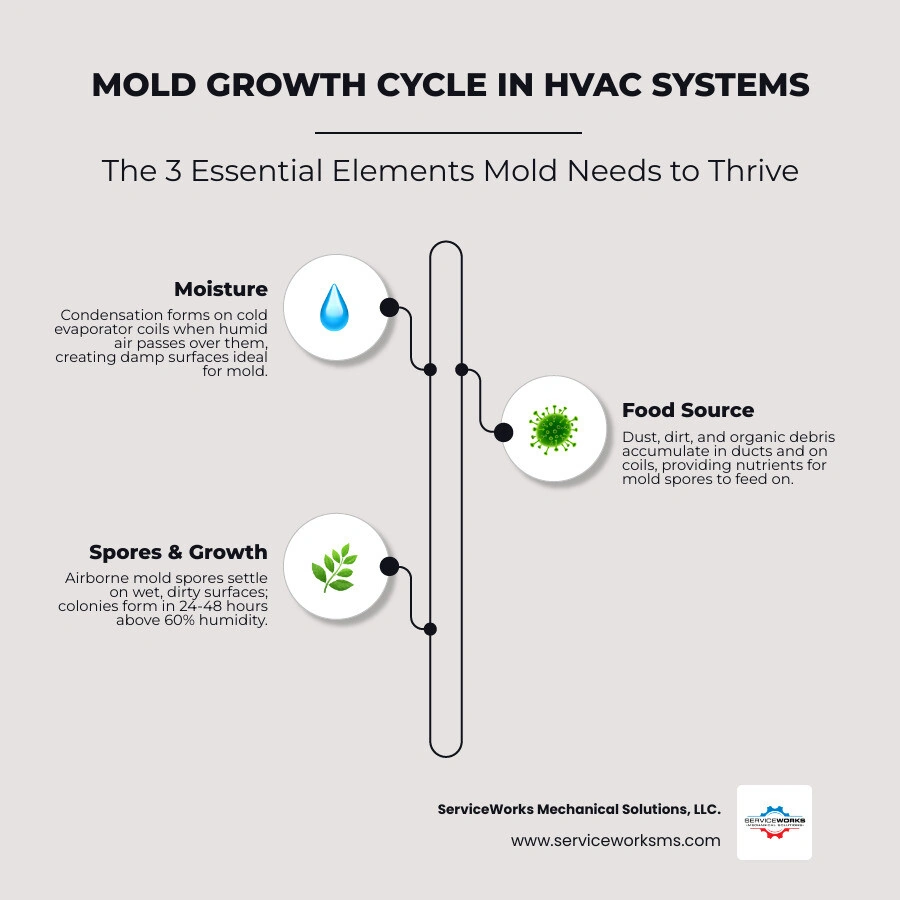
To understand how proper hvac maintenance prevents mold growth, we first have to look at the three things mold needs to survive: moisture, a food source (like dust or skin cells), and a surface to grow on. Your HVAC system naturally provides all three if it isn't cared for correctly.
In April 2026, as we move into the warmer months in South Carolina, your air conditioner works by pulling warm, humid air across a very cold evaporator coil. This process causes moisture to condense out of the air—much like the "sweat" on a cold glass of sweet tea on a porch in Georgetown. This water is supposed to drip into a pan and flow out of your house through a drain line.
However, if the system is dirty or poorly maintained, that water doesn't leave. It sits. When moisture lingers on a dirty evaporator coil or in a clogged drain pan, mold spores (which are microscopic and always floating around) find a five-star resort to start a colony. If you notice your AC Not Cooling Properly in Humid Heat, it might be due to a frozen or dirty coil, which is a prime breeding ground for these "sneaky little buggers."
Optimizing Airflow: How Proper HVAC Maintenance Prevents Mold Growth
Airflow is the enemy of mold. Mold loves stagnant, still air where humidity can hang heavy. When your HVAC system has restricted airflow—usually caused by a clogged air filter or blocked vents—the air inside your ducts becomes "lazy." It doesn't move fast enough to keep surfaces dry.
Furthermore, a well-maintained system ensures that dust doesn't accumulate. Dust is organic matter—it’s essentially "mold food." By keeping the internal components clean through regular HVAC Maintenance North Myrtle Beach, you are effectively removing the buffet that mold needs to grow. Without food and with plenty of moving air, mold simply can't get a foothold.
Managing Humidity: How Proper HVAC Maintenance Prevents Mold Growth
In coastal areas like Surfside Beach and Murrells Inlet, the outdoor humidity is often well above 80%. Your HVAC system is your primary defense against this moisture. To prevent mold, the goal is to keep your indoor relative humidity (RH) between 30% and 50%.
If your humidity levels climb toward 60%, you are entering the "danger zone." We recommend homeowners use a simple tool called a hygrometer (a humidity sensor) to monitor their indoor air. If you find that your home feels "sticky" or your windows have condensation on the inside, your HVAC system may be struggling to keep up. This is often where professional Duct Cleaning Surfside Beach comes into play, ensuring that the pathways for your air are dry and sealed against the humid South Carolina air.
Identifying the Warning Signs of Mold in Coastal HVAC Systems

Since mold often grows in the dark recesses of your ductwork or behind the service panel of your air handler, you might not see it right away. However, your senses will usually tell you something is wrong.
- The "Dirty Sock" Smell: This is the most common sign. If you turn on your AC and smell a musty, earthy, or "locker room" odor, you likely have mold or bacteria growing on your coils or in your ducts.
- Visible Patches: Look closely at your register vents and grilles. Do you see black, green, or white fuzzy spots? This isn't just "dust"—it’s often mold thriving on the condensation that forms when cold air hits the warm vent.
- Physical Symptoms: Are you sneezing more often? Do you have a persistent cough or itchy eyes that only seem to act up when you’re at home? Mold spores circulating through your vents can trigger significant allergy symptoms and respiratory irritation.
- Excessive Condensation: If you see water dripping from your vents or standing water in your secondary drain pan (the one under your unit in the attic or closet), you have a moisture problem that will lead to mold in 24 to 48 hours.
If you spot these signs, it's time to look into professional Duct Cleaning Myrtle Beach to safely remove the infestation before it spreads to your carpets and furniture.
Essential DIY Maintenance Steps for Homeowners
While we always recommend professional oversight, there are several things you can do right now to protect your home. Think of these as the "daily vitamins" for your HVAC system.
- The 30-90 Day Filter Rule: This is the single most important DIY task. A dirty filter slows down airflow, causing the evaporator coil to get too cold and create excess moisture. In a humid climate like Florence or Conway, check your filter monthly. If it looks grey and fuzzy, swap it out. You can find more tips in our AC Maintenance Florence Complete Guide.
- Clear the Condensate Line: Locate your PVC drain line outside. Is it dripping? It should be when the AC is running! You can pour a cup of white vinegar followed by warm water down the drain line access point (usually a T-shaped pipe near the indoor unit) every few months to kill algae and prevent clogs.
- Vent Hygiene: Use a vacuum attachment to clean your registers and return grilles. Keeping these free of dust removes the "food" that mold spores need to settle and grow.
- Keep Vents Open: It might be tempting to close vents in unused rooms, but this actually disrupts the system's pressure and slows down airflow, which can lead to moisture buildup in the ducts. Keep them open!
Advanced Strategies and Equipment for Superior Mold Prevention
For homeowners who want the ultimate "mold-proof" setup, modern technology offers some incredible solutions. These are especially helpful for families in Pawleys Island or Socastee who suffer from severe allergies.
- UV Germicidal Lights: These are installed directly inside your HVAC unit, usually near the evaporator coil. They emit a specific wavelength of UVC light that destroys the DNA of mold spores, viruses, and bacteria, effectively "zapping" them before they can reproduce.
- Whole-Home Dehumidifiers: Sometimes, even a perfectly running AC unit can't keep up with South Carolina's humidity. A whole-home dehumidifier works with your HVAC system to pull gallons of moisture out of the air every day, ensuring your RH stays in that 30-50% sweet spot.
- Duct Sealing: Leaky ducts in a hot attic act like a vacuum, sucking in humid, dusty air. Sealing these leaks ensures that only filtered, conditioned air moves through your home. This is a key part of Duct Cleaning Pawleys Island services.
Filter Comparison Table
| Filter Type | MERV Rating | Mold Spore Filtration | Recommended Use |
|---|---|---|---|
| Standard Fiberglass | 1–4 | Low | Basic protection for the motor only. |
| Pleated Filter | 5–8 | Moderate | Good for general home use; traps some spores. |
| High-Efficiency | 8–13 | High | Best for mold prevention and allergies. |
| HEPA Filter | 17–20 | Maximum | Usually requires system modifications for airflow. |
When to Consult a Professional for Inspection and Remediation
There comes a point where DIY isn't enough. Mold is a biological hazard, and if handled incorrectly, you can actually spread the spores further into your home. You should call us if:
- You see significant mold growth: If the mold covers more than a few square inches, it requires professional remediation.
- You’ve had a leak or flood: If your drain pan overflowed or a pipe leaked near your ducts, the insulation inside your system may be wet. Wet insulation cannot be "cleaned"—it must be replaced by a pro.
- The smell won't go away: If you’ve changed the filter and cleaned the vents but the musty odor remains, the mold is likely deep inside the air handler or ductwork.
- It’s time for your seasonal tune-up: We recommend a professional inspection twice a year. We check the "hidden" spots like the blower motor, the back of the evaporator coil, and the deep seal traps in the drain lines.
Whether you need Duct Cleaning Charleston or a system evaluation in Goose Creek, our licensed technicians have the tools to measure moisture levels and detect issues before they become "scary" problems.
Long-Term Benefits of Consistent HVAC Care
Investing in how proper hvac maintenance prevents mold growth isn't just about avoiding a bad smell—it’s about protecting your biggest investment: your home.
- Lower Energy Bills: A system free of mold and dust doesn't have to work as hard. When coils are clean, heat transfer is efficient, which keeps your monthly power bills in check.
- Extended Equipment Life: Mold and moisture cause corrosion. By keeping the system dry and clean, you can add years to the lifespan of your air conditioner.
- Better Air Quality: You’ll breathe easier knowing your family isn't inhaling microscopic spores every time the fan kicks on.
- Saving Money: As many homeowners ask, Do AC Maintenance Plans Save Money? The answer is a resounding yes. The cost of a yearly maintenance plan is a fraction of the cost of professional mold remediation or a full system replacement.
Frequently Asked Questions about HVAC Mold
How quickly can mold begin to grow in my air ducts?
Mold is incredibly fast. If there is standing water and organic matter (dust), colonies can begin to form within 24 to 48 hours. This is why it is critical to address any AC leaks or "sweating" ducts immediately.
What is the ideal indoor humidity level to prevent mold growth?
According to the EPA and our local expertise in the coastal South Carolina climate, you should aim to keep your indoor relative humidity between 30% and 50%. Anything above 60% significantly increases the risk of mold growth.
How often should I replace my air filters in a humid climate?
In areas like Myrtle Beach or Surfside Beach, we recommend checking your filters every 30 days. While some high-end filters claim to last 90 days, the high humidity and salt air can cause them to clog faster. If you have pets or smokers in the home, monthly changes are a must.
Conclusion
At ServiceWorks Mechanical Solutions, LLC, we know that a healthy home starts with the air you breathe. As a veteran-owned company based in Surfside Beach, we’ve seen how the South Carolina humidity can turn a neglected HVAC system into a "mold factory."
Don't wait for a musty smell or an allergy flare-up to take action. From Little River to Loris and down to Georgetown, our licensed and experienced technicians are ready to help you maintain a comfortable, safe, and mold-free environment. Whether you need a routine tune-up, advanced air quality solutions, or emergency repairs, we provide dependable service with a 100% satisfaction guarantee.
Ready to protect your home's air quality? Explore our full range of HVAC Services and let us help you breathe easy today.
testimonials
Customer Testimonials

With approved credit through Wisetack, you can enjoy zero down financing and convenient monthly payments, so you don’t have to wait to get the comfort you deserve.
Recent Blog
Stay updated with our latest blog posts.

Why Is My Home So Humid? How Your HVAC System Controls Indoor Humidity in South Carolina