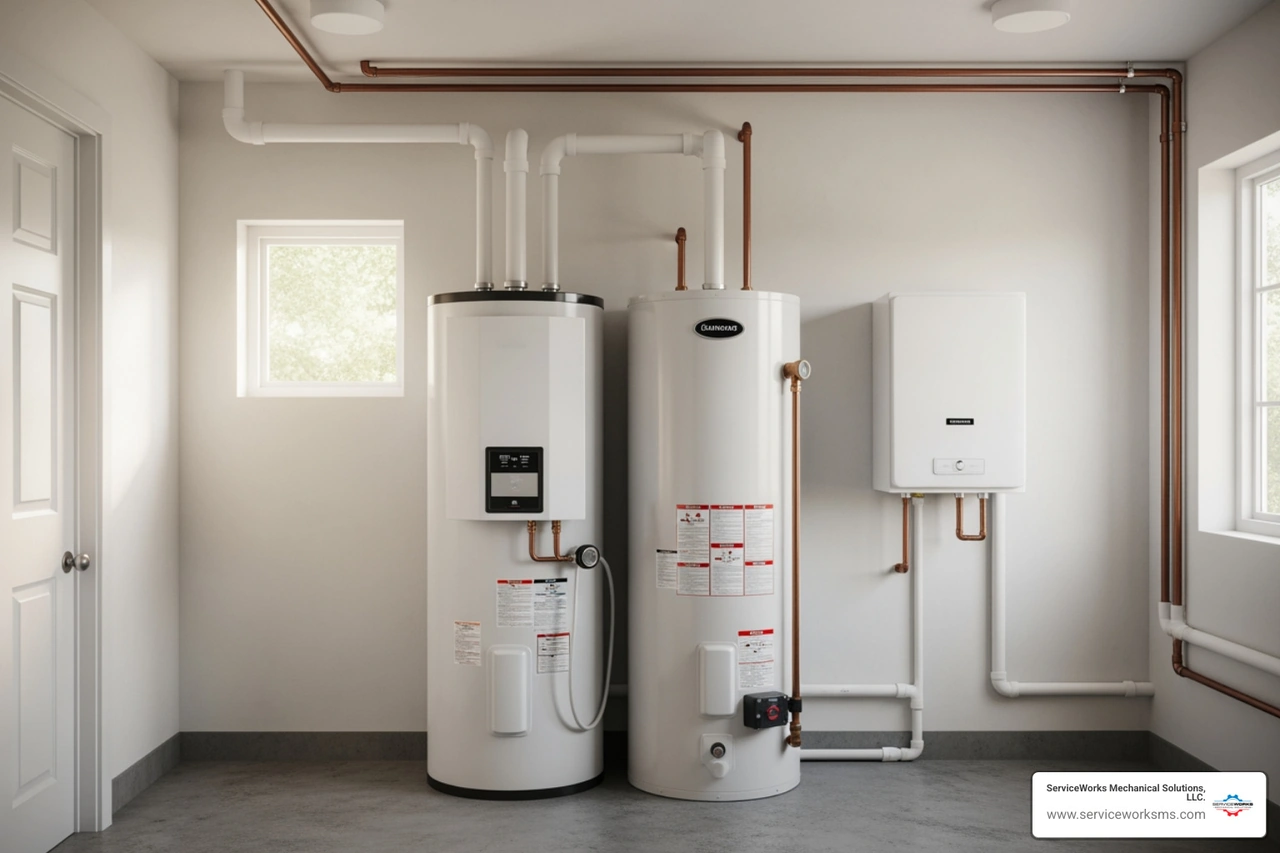
The Real Difference Between Tankless and Tank Water Heaters — And How to Choose
When it comes to a tankless vs tank water heater comparison, here is the short answer most homeowners need:
| Factor | Tankless | Tank |
|---|---|---|
| How it works | Heats water on demand | Stores and reheats water continuously |
| Hot water supply | Unlimited (flow-rate dependent) | Limited by tank size (30–80 gallons) |
| Energy efficiency | 8–34% more efficient than tank | Less efficient due to standby heat loss |
| Lifespan | 20+ years | 10–15 years |
| Upfront complexity | Higher — often requires upgrades | Lower — simpler swap |
| Space required | Wall-mounted, very compact | Large floor footprint |
| Best for | Smaller households, long-term owners | High simultaneous demand, tight budgets |
Your water heater is one of the hardest-working appliances in your home. It powers your morning shower, runs your dishwasher, and keeps laundry cycles hot — every single day. When it fails, or when it is time to replace it, you face a real choice: stick with the familiar storage tank, or make the switch to an on-demand tankless system?
Both have genuine advantages. Both have real drawbacks. And the right answer depends on your home's layout, your family's hot water habits, and how long you plan to stay in the house. For homeowners along the South Carolina coast, local conditions — like warm groundwater temperatures and humid weather — can actually tip the scales in ways that general guides often miss.
This article walks through everything you need to know to make a confident, well-informed decision.

Tankless vs Tank Water Heater Comparison: The Core Differences
At the simplest level, a tank water heater stores hot water, while a tankless unit makes hot water only when you call for it. That one difference changes almost everything: efficiency, space needs, maintenance, performance, and lifespan.
| Feature | Tankless Water Heater | Traditional Tank Water Heater |
|---|---|---|
| Heating method | On-demand through heat exchanger | Stored hot water in insulated tank |
| Main efficiency issue | Can lose performance if undersized or scaled | Standby heat loss |
| Output measure | Flow rate in gallons per minute | Tank size and first-hour rating |
| Typical service life | 20 years or more | 10-15 years |
| Footprint | Compact, wall-mounted | Larger floor-standing unit |
| Best performance style | Staggered hot water use | Heavy simultaneous use |
How a Traditional Tank Water Heater Works
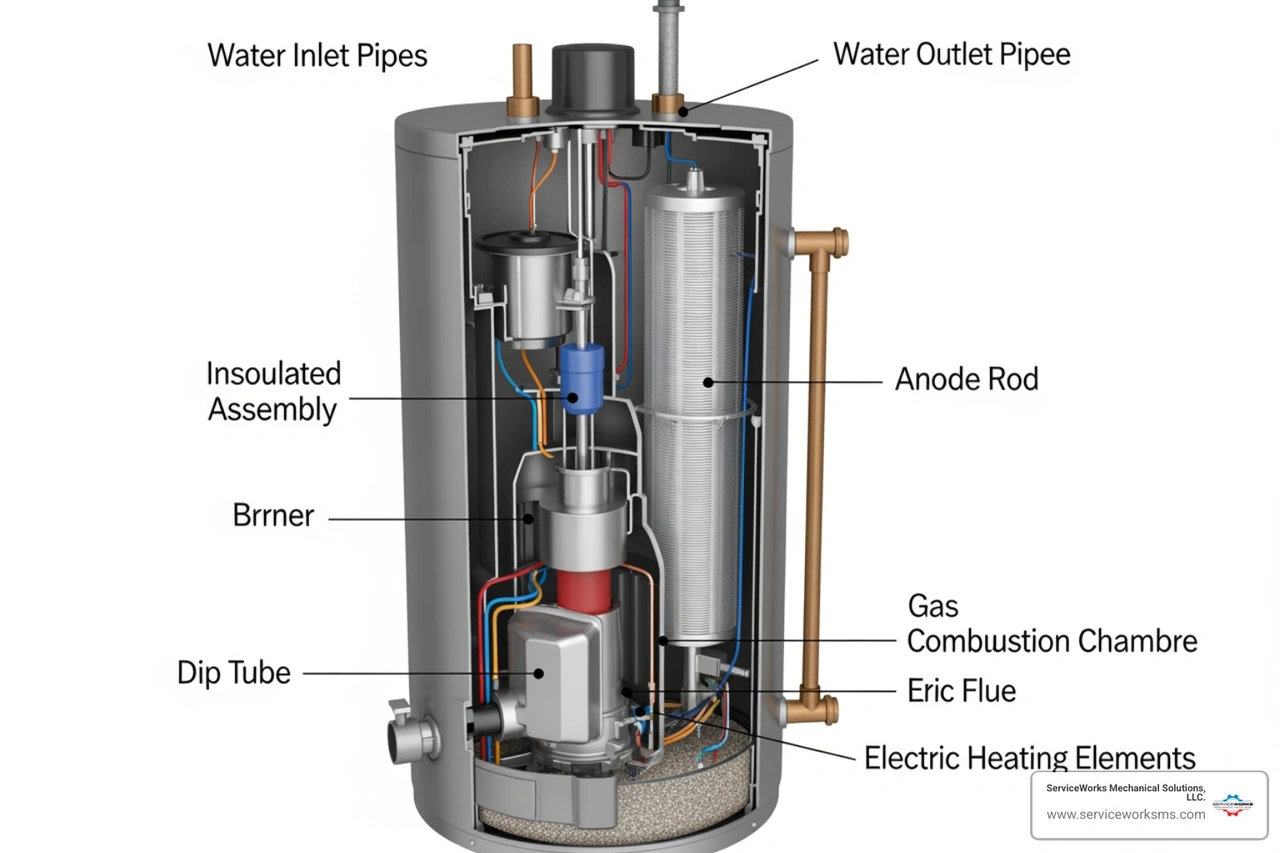
A standard tank heater keeps a reservoir of water hot and ready, usually in the 30- to 80-gallon range. Inside the tank, gas burners or electric heating elements warm the stored water. A thermostat monitors temperature and turns the heat source on again as the water cools.
That means the unit cycles on and off all day, even when no one is showering or washing dishes. This is the source of standby heat loss: energy used to keep water hot while it waits.
Tank systems also rely on an anode rod to slow internal corrosion. Over time, sediment settles in the bottom of the tank, especially if water minerals are present. That buildup can reduce efficiency, increase noise, and shorten service life.
A tank heater's real-world performance is usually judged by its first-hour rating, or how much hot water it can deliver in the first hour when starting with a full tank. That is why some 50-gallon models can actually deliver much more than 50 gallons in that first hour.
How a Tankless Water Heater Works
A tankless water heater has no storage tank. When you open a hot water tap, cold water flows through the unit and passes over a heat exchanger. A gas burner or electric elements heat the water as it moves through, so hot water is produced on demand.
This design removes standby loss because the system is not storing and reheating water all day. That is why tankless systems can be 24% to 34% more energy efficient in homes using 41 gallons of hot water or less per day. In heavier-use households, the efficiency edge is still real, but smaller, usually around 8% to 14%.
Most whole-home tankless systems are rated by flow rate, commonly around 2 to 5 gallons per minute for many standard units, though larger models can do more. Gas models generally produce higher flow rates than electric models.
One quirk: tankless systems need a minimum flow to activate. If the water is only trickling, the unit may not fire. Translation: your faucet's tiny "just rinsing my toothbrush" setting may not impress it.
Why Performance Feels Different in Daily Use
Tank and tankless systems can both provide excellent hot water, but they feel different in everyday life.
A tank heater is great at short bursts of heavy, simultaneous use because it already has hot water stored. If two showers and the dishwasher start around the same time, a properly sized tank often handles that well, at least until the stored volume runs low.
A tankless system shines with back-to-back use. As long as demand stays within the unit's flow rate, hot water keeps coming. No waiting for the tank to refill and recover.
Where tankless can struggle is overlap. A shower, washing machine, and dishwasher running together may exceed the unit's gallons-per-minute capacity. Some homeowners also notice the "cold water sandwich," a brief burst of cool water between short hot-water draws.
Pros and Cons of Each Water Heater Type
There is no universal winner in a tankless vs tank water heater comparison. The better choice depends on what matters most in your home: space, simplicity, energy savings, long-term value, or peak-demand performance.
Tankless Water Heater Pros and Cons
Tankless pros:
- Higher efficiency because there is no standby heat loss
- Longer service life, often 20 years or more
- Very compact wall-mounted design
- Endless hot water when the unit is sized correctly
- Lower risk of a large tank leak flooding the area
Tankless cons:
- More complex installation, especially when replacing a tank
- Performance depends heavily on proper sizing
- Annual descaling is important, especially with mineral-heavy water
- Simultaneous hot water demand can exceed capacity
- Gas and electric utility upgrades may be needed in some homes
For homeowners interested in local tankless solutions, see tankless water heater service in Myrtle Beach, SC.
Traditional Tank Water Heater Pros and Cons
Tank pros:
- Simpler, familiar technology
- Easier replacement in homes already set up for a tank
- Handles high simultaneous demand well for short periods
- Repairs are often more straightforward
- Good fit for emergency replacement situations
Tank cons:
- Uses more energy because stored water loses heat over time
- Hot water can run out during heavy use
- Larger footprint in closets, garages, or utility rooms
- Sediment buildup can reduce efficiency
- Tank corrosion and leaks become more likely with age
Research also shows tank systems are more vulnerable to major water damage if the tank fails, since a leaking tank can release a large volume of stored water at once.
Which Type Usually Fits Better by Household Situation
In general, tankless tends to fit best when:
- You want to free up floor space
- You plan to stay in the home long term
- Your household uses hot water in a more staggered pattern
- You want longer equipment life
- You live in coastal South Carolina, where warmer groundwater can help tankless performance
A traditional tank often fits better when:
- You need a simple replacement fast
- Your family uses lots of hot water at the same time
- You prefer lower installation complexity
- Your home already has a tank setup that works well
- You want the most familiar operation possible
Vacation homes and smaller primary residences can also be strong candidates for tankless, since there is less wasted energy keeping water hot when no one is there.
Operating Efficiency, Lifespan, and Maintenance
Energy Efficiency and Long-Term Savings
Tankless systems save energy mainly by avoiding standby losses. That is the heat wasted while a storage tank sits there doing its best impression of a giant thermos.
Research consistently shows:
- Tankless units are 24% to 34% more energy efficient in homes using 41 gallons or less of hot water daily
- In homes using around 86 gallons per day, tankless units are still 8% to 14% more efficient
- Many homeowners save around $100 or more annually with gas tankless compared with a standard tank
- Savings for electric tankless versus electric tank can be smaller and depend heavily on the home's setup
In coastal South Carolina, incoming groundwater is warmer than in colder northern climates. That matters because a tankless unit does not have to raise the water temperature as dramatically. In practical terms, that can improve performance and make the technology more homeowner-friendly here than in colder regions.
Which Lasts Longer and What Affects Lifespan
On lifespan, tankless generally wins.
Typical expectations:
- Tankless water heaters: 20+ years
- Tank water heaters: 10-15 years
Why the difference? Tank systems hold water constantly, which means more long-term exposure to corrosion, sediment, and internal wear. Tankless systems avoid stored-water corrosion and often have serviceable parts that can be replaced individually.
That said, lifespan is not automatic. Hard water, skipped maintenance, poor installation, and oversizing or undersizing can shorten the life of either system. Tank heaters need healthy anode rods and sediment control. Tankless units need clean heat exchangers and scale prevention.
Maintenance Requirements Homeowners Should Expect
Both types need maintenance, just in different ways.
Tank water heater maintenance usually includes:
- Flushing sediment from the tank
- Checking the anode rod
- Inspecting the temperature and pressure relief valve
- Watching for rust, drips, or strange noises
Tankless maintenance usually includes:
- Annual descaling or flushing
- Cleaning filters or inlet screens
- Inspecting burners, venting, or electrical connections
- Checking for mineral buildup that can restrict flow
If your home has harder water, tankless maintenance becomes more important. Scale inside the heat exchanger can reduce flow and efficiency fast.
For repair, maintenance, or replacement help, visit our main water heater service page.
Sizing, Space, and Whole-Home Hot Water Demand
Can a Tankless Unit Handle a Whole House or Large Family?
Yes, a tankless unit can handle a whole house, but only if it is sized correctly for peak demand, not average demand.
That means we look at how many fixtures may run at the same time:
- Shower: often around 2 to 2.5 GPM
- Dishwasher: roughly 1 to 2 GPM
- Washing machine: roughly 2 to 3 GPM
If a home might run two showers and a dishwasher at once, the unit needs to support that total demand at the desired temperature rise. Large homes may need a high-capacity gas tankless system or even multiple units.
This is where many homeowners get tripped up. Endless hot water does not mean unlimited hot water to every fixture all at once. It means continuous hot water within the unit's flow limits.
Space Requirements for Tankless vs Tank Systems
Tankless clearly wins on footprint.
A traditional tank takes up floor space and often needs a dedicated corner of a garage, utility room, or closet. A tankless system mounts on the wall and frees up usable square footage.
Still, "small" does not mean "install anywhere." Tankless units need proper clearances, access for service, and an appropriate vent path for gas models. Electric models need space around electrical connections and service panels.
For condos, townhomes, and homes with tight utility closets, this smaller size can be a major advantage.
How Climate and Groundwater Temperature Change the Answer
This is one of the most overlooked parts of a tankless vs tank water heater comparison.
In South Carolina coastal communities like Myrtle Beach, Charleston, Conway, Summerville, and Surfside Beach, incoming groundwater is generally warmer than in cold-climate states. That reduces the temperature rise the heater must achieve.
Why that matters:
- Tankless units can deliver better GPM performance in warmer climates
- Electric tankless options are somewhat more practical here than in colder areas
- Winter performance still matters, but the seasonal drop is usually less severe than in northern regions
So while national articles often warn that tankless struggles in cold weather, that warning is less dramatic for our service area.
Gas vs Electric and What to Expect During Installation
Gas vs Electric Tank Water Heaters
Gas tank water heaters usually recover faster, which helps when several people need hot water close together. They also continue to be a common choice in homes already set up with gas service.
Electric tank heaters are simpler in some homes because they do not need combustion venting. They can also have fewer combustion-related parts to maintain. But recovery time is often slower than gas.
If utility access already exists, both can work well. The better choice depends on the home's fuel source, venting options, and hot water habits.
Gas vs Electric Tankless Water Heaters
Gas tankless units generally outperform electric tankless units in whole-house applications because they can deliver higher GPM. They are often the go-to choice for larger households.
Electric tankless units can work in smaller homes or point-of-use situations, but they may require substantial electrical capacity. Some whole-house electric tankless systems need very high amperage and may require panel upgrades.
Gas tankless units bring their own installation needs:
- Proper venting
- Adequate gas supply
- Possible condensate drainage for condensing models
- A standard power connection for controls and ignition
Modern gas tankless systems may be condensing or non-condensing. Condensing units recover more heat from exhaust gases, improving efficiency.
Installation Challenges When Switching From Tank to Tankless
This is where the easy internet answer of "just swap it" usually falls apart.
Switching from tank to tankless may involve:
- Upsizing the gas line
- Reworking venting
- Adding a condensate drain
- Upgrading electrical service or breakers
- Changing water line layout
- Planning for recirculation if quicker delivery is desired
Older homes can be especially tricky because existing mechanical spaces were not designed for modern on-demand equipment.
That is why professional sizing and installation matter so much. A tankless system that is too small, poorly vented, or improperly flushed is not a bargain. It is a future headache with plumbing attached.
For local help with conversion projects, see tankless water heater service in Surfside Beach, SC.
How to Choose the Right Water Heater for Your Home
When Tankless Is Worth It
Tankless is often worth it when:
- You plan to stay in the home for years
- You want lower energy use
- You have limited installation space
- Your household's hot water use is moderate or staggered
- You want longer lifespan and lower standby loss
- Your home is in a warmer coastal South Carolina climate
If that sounds like your household, learn more about tankless water heater options in Charleston, SC.
When Sticking With a Tank Makes More Sense
A traditional tank may be the smarter choice when:
- You need a fast, simple replacement
- Your household often stacks multiple hot-water uses at once
- You want lower installation complexity
- You prefer a familiar setup
- You are replacing a failed unit in an emergency
For many families, a tank is not "old-fashioned." It is just practical.
Best Next Step for Coastal South Carolina Homeowners
The best choice comes from looking at the whole picture:
- Household size
- Number of bathrooms
- Peak hot water demand
- Available gas or electric service
- Space constraints
- Water quality
- Long-term ownership plans
At ServiceWorks Mechanical Solutions, LLC, we recommend starting with a home-specific assessment instead of a one-size-fits-all answer. Coastal South Carolina homes have different layouts, usage patterns, and climate conditions than national guides assume.
Explore our full water heater services to get started.
Frequently Asked Questions About Tankless vs Tank Water Heater Comparison
Is a tankless water heater worth the higher upfront cost?
It can be, especially if you value efficiency, longer lifespan, and space savings, and you expect to stay in the home long enough to enjoy those benefits. But it is not automatically the best financial move for every homeowner. If your main goal is the simplest replacement and your current tank setup works well, a traditional tank may still be the better fit.
What are the biggest downsides of tankless water heaters?
The biggest drawbacks are flow limits during simultaneous demand, more complex retrofits, annual descaling needs, and sensitivity to mineral buildup. Some homeowners also notice activation thresholds and the occasional cold water sandwich effect.
Can I replace a 50-gallon tank with a tankless unit?
Yes, but the right replacement is based on gallons per minute and temperature rise, not tank size alone. We need to look at how many fixtures you run at once, whether the home uses gas or electric, and what upgrades may be needed for venting, gas piping, or electrical load.
If you are considering that switch, see tankless water heater service in Conway, SC.
Conclusion
In the end, the best tankless vs tank water heater comparison is the one that matches real life in your home.
Choose tankless if you want compact size, longer service life, better efficiency, and on-demand hot water that fits your household's usage pattern.
Choose a tank if you want simpler installation, easier replacement, and strong performance during heavy simultaneous use.
For homeowners across coastal South Carolina, warmer groundwater can make tankless more attractive than national articles suggest, but proper sizing still makes all the difference. The smartest next step is a professional assessment based on your home's layout, fuel source, and daily hot water routine.
For help choosing, repairing, or replacing your system, visit our water heater page.
testimonials
Customer Testimonials

With approved credit through Wisetack, you can enjoy zero down financing and convenient monthly payments, so you don’t have to wait to get the comfort you deserve.
Recent Blog
Stay updated with our latest blog posts.
Commercial HVAC Replacement Planning: How to Know When It’s Time to Replace Your System