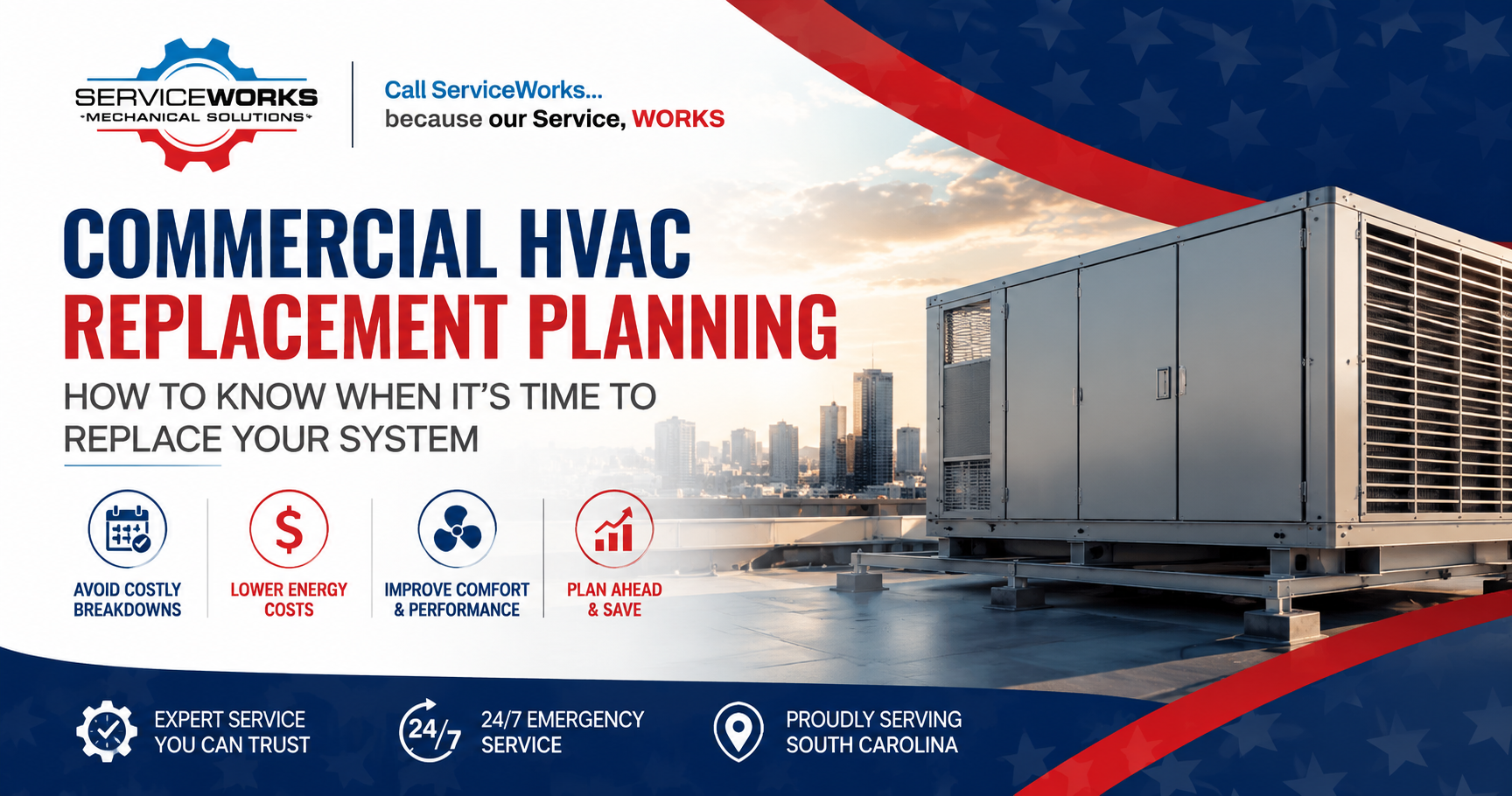
Commercial HVAC Replacement Planning: How to Know When It’s Time to Replace Your System
Commercial HVAC systems play an important role in keeping businesses comfortable, productive, and operational. Whether you manage an office building, retail property, restaurant, warehouse, or other commercial facility, your heating and cooling equipment may operate for thousands of hours each year.
Eventually, even well-maintained equipment reaches a point where continued repairs may no longer be the best investment. Waiting until a system completely fails can leave a business dealing with unexpected downtime, uncomfortable indoor conditions, emergency repair expenses, and rushed replacement decisions.
Commercial HVAC replacement planning allows businesses and facility managers to evaluate aging equipment before an emergency occurs. By recognizing the warning signs and planning ahead, you can make more informed decisions about when to repair equipment and when replacement makes better long-term sense.
How Long Does a Commercial HVAC System Last?
There is no single lifespan that applies to every commercial HVAC system. Equipment longevity depends on several factors, including the type of system, operating hours, maintenance history, installation quality, environmental conditions, and how heavily the equipment is used.
A commercial system that receives regular preventive maintenance may perform reliably for many years. Equipment that operates under heavy loads or has experienced inconsistent maintenance may develop problems sooner.
Instead of making replacement decisions based solely on age, businesses should consider the overall condition and performance of the system. An older unit that remains efficient and reliable may still have useful life remaining, while a newer system experiencing repeated problems may need a more thorough evaluation.
Warning Signs a Commercial HVAC System May Need Replacement
HVAC equipment usually provides some indication that performance is beginning to decline. Recognizing these signs early gives facility managers more time to evaluate their options.
Repair Calls Are Becoming More Frequent
An occasional HVAC repair does not necessarily mean the entire system needs to be replaced. However, repeated service calls can indicate that multiple components are beginning to wear out.
Look at the system's recent repair history. If technicians are being called more frequently or different components continue failing, it may be time to compare the cost of ongoing repairs with the potential benefits of replacement.
Repair history can be especially valuable when managing multiple rooftop units or other equipment across a commercial property. Tracking which units require the most attention helps identify equipment that may be approaching the end of its practical service life.
Energy Costs Are Increasing
Commercial HVAC equipment can account for a significant portion of a building's energy use. As systems age or lose efficiency, they may need to operate longer to maintain the desired indoor temperature.
Higher energy bills do not automatically mean the HVAC system needs replacement. Dirty components, airflow restrictions, control problems, building changes, or maintenance issues can also increase energy consumption.
However, unexplained increases in energy use combined with aging equipment or declining performance can be a reason to have the system evaluated.
Temperatures Are Becoming Inconsistent
Hot and cold areas throughout a commercial building can create problems for employees, customers, tenants, and equipment.
Temperature inconsistencies may be caused by airflow problems, controls, ductwork, building modifications, or improper system balancing. In other situations, the existing HVAC equipment may no longer be able to meet the building's current heating and cooling requirements.
Before replacing equipment, a commercial HVAC professional should determine what is actually causing the comfort problem.
Your Building May Have Changed Since the HVAC System Was Installed
Commercial properties rarely remain exactly the same throughout the life of their HVAC equipment.
Businesses add employees, rearrange workspaces, install equipment, construct new walls, expand offices, or change how areas of the building are used. Each of these changes can affect heating and cooling requirements.
For example, an area originally designed as storage space may later become an office filled with employees and computers. The HVAC system serving that area may not have been designed for the additional heat load.
Replacement planning provides an opportunity to evaluate the building as it operates today instead of automatically replacing old equipment with equipment of the same size or configuration.
Repair or Replace? Look Beyond the Immediate Cost
When commercial HVAC equipment fails, repairing it can appear to be the least expensive option because the upfront cost is typically lower than replacement.
But the immediate repair bill is only one part of the decision.
Facility managers should also consider:
- The age and overall condition of the equipment
- Frequency and cost of recent repairs
- Availability of replacement components
- Current energy performance
- Comfort problems throughout the building
- Maintenance requirements
- The likelihood of additional failures
- How important the equipment is to business operations
A repair may make sense when the equipment is otherwise reliable and the problem is isolated. If the system requires increasingly expensive repairs while performance continues to decline, replacement may provide better long-term value.
Why Planning Replacement Before Failure Matters
One of the biggest advantages of commercial HVAC replacement planning is having time to make decisions.
When critical equipment fails during extremely hot or cold weather, restoring building comfort becomes the immediate priority. Businesses may have fewer options regarding equipment selection, scheduling, budgeting, and installation timing.
Planning ahead allows you to evaluate available systems, determine what the building actually needs, and schedule work around business operations when possible.
It can also help organizations incorporate HVAC replacement into capital planning instead of treating every major equipment failure as an unexpected expense.
For facilities with several HVAC units, replacement planning does not necessarily mean replacing everything at once. Equipment can often be prioritized based on condition, age, performance, and operational importance.
Consider the Cost of HVAC Downtime
HVAC problems affect more than indoor temperature.
Depending on the type of facility, an HVAC failure could disrupt employees, customers, tenants, inventory, technology, or other temperature-sensitive operations.
A restaurant may struggle to keep customers and employees comfortable during a summer outage. An office may experience productivity problems. Some commercial environments may contain equipment or materials that require specific temperature conditions.
When deciding whether to continue repairing aging equipment, consider the potential impact if that system experiences an unexpected failure.
For critical areas of a facility, reliability may be just as important as repair and replacement costs.
Don't Automatically Replace Equipment With the Same System
Replacing commercial HVAC equipment provides an opportunity to examine whether the existing configuration still makes sense.
Commercial HVAC technology, building usage, efficiency expectations, and control capabilities can change significantly over the life of a system.
Before selecting replacement equipment, businesses should evaluate factors such as:
- Current building size and layout
- Occupancy levels
- Operating schedules
- Heating and cooling loads
- Existing ductwork and airflow
- Controls and zoning
- Energy efficiency goals
- Plans for future expansion or renovation
Proper planning helps ensure the replacement system is selected for the facility's current requirements rather than simply matching equipment installed many years ago.
Start With a Commercial HVAC Assessment
You do not need to wait for an HVAC failure to begin replacement planning.
A professional assessment can help identify aging equipment, performance concerns, maintenance needs, and systems that may require attention in the coming years. This information can help businesses prioritize investments and develop a more predictable approach to HVAC expenses.
ServiceWorks Mechanical Solutions provides commercial HVAC services for businesses throughout South Carolina. Whether you are dealing with an aging system, repeated repairs, inconsistent building temperatures, or planning future equipment upgrades, our team can evaluate your commercial HVAC needs and help you understand your options.
Planning ahead gives your business more control over when and how HVAC replacement occurs.
Visit ServiceWorks Mechanical Solutions to learn more about commercial HVAC services or schedule an assessment for your facility. As we like to say, call ServiceWorks because our service, works!
testimonials
Customer Testimonials

With approved credit through Wisetack, you can enjoy zero down financing and convenient monthly payments, so you don’t have to wait to get the comfort you deserve.
Recent Blog
Stay updated with our latest blog posts.
Why Is My Home So Humid? How Your HVAC System Controls Indoor Humidity in South Carolina